Because cloud computing offers scalable resources and reduces upfront infrastructure expenses, it has fundamentally altered how businesses operate. However, cloud costs can increase rapidly without adequate management. Therefore, Organizations can minimize spending while preserving performance and scalability by implementing cloud cost reduction solutions. In this blog, we’ll look at doable strategies that help companies achieve effective cloud cost reduction without sacrificing system performance.
Key Cloud Cost Reduction Techniques
1. Proper Resource Sizing
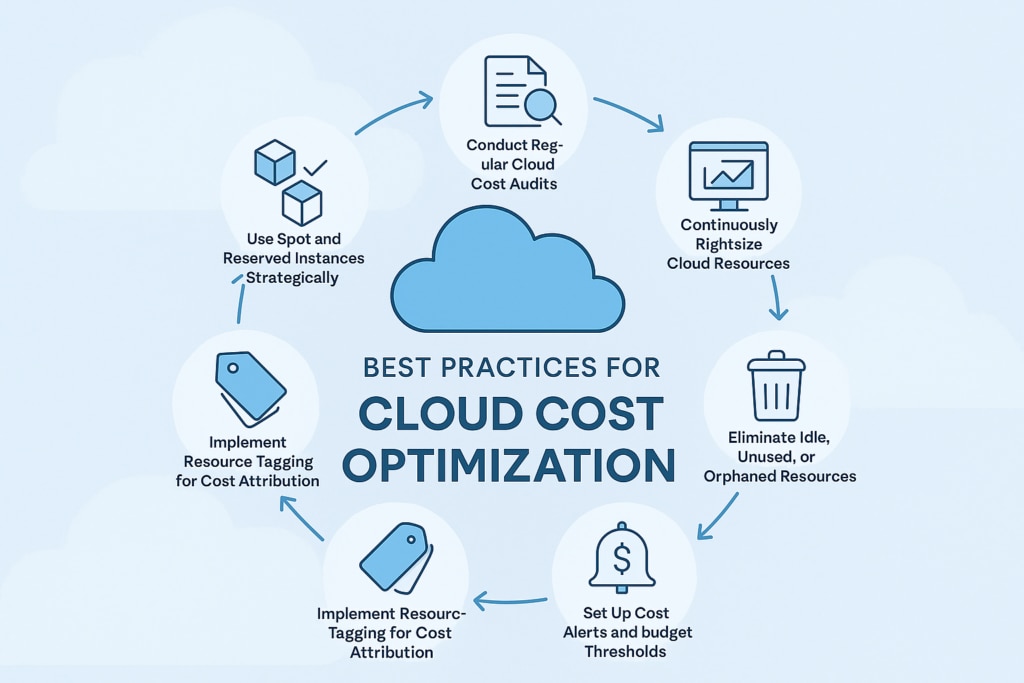
First, over-provisioning resources is one of the most frequent causes of excessive cloud expenses. Analyzing workloads and choosing the best instance sizes and types is known as “right-sizing.” To find unused resources, use tools offered by cloud platforms such as Google Cloud’s Recommender, Azure Advisor, and AWS Trusted Advisor. These tools help companies implement effective cloud cost reduction strategies.
For official best practices on managing and optimizing cloud costs, refer to the documentation provided by Amazon Web Services and Microsoft Azure.
2. Make Use of Savings Plans and Reserved Instances
Long-term commitments are eligible for savings from cloud providers. Additionally, businesses can pre-purchase resources at a substantially reduced cost than on-demand pricing with Reserved Instances (RIs) and Savings Plans. To optimize savings, examine consumption trends before committing to these programs.
3. Auto-Scaling for Cloud Cost Reduction
As a result, resources are automatically adjusted by auto-scaling in response to demand and traffic. This guarantees that companies only pay for the resources they utilize. Putting auto-scaling policies into place promotes effective cloud cost reduction and helps prevent paying for idle capacity.
4. Consistently track and evaluate usage
Moreover, monitoring tools offer useful information about resource usage and system performance. Unused resources like idle virtual machines, storage volumes, or out-of-date snapshots can be found with the aid of services like AWS CloudWatch, Azure Monitor, and Google Cloud Operations Suite. For ongoing cloud cost reduction, regular monitoring is crucial.
You can also read our blog on Monitor Cost Control with Microsoft Copilot Systems to gain deeper insights into tracking and optimizing cloud spending.
5. Put Cost Allocation Tags In Place
Tracking expenditures across various teams, projects, or departments is made easier by tagging resources. Businesses may more efficiently allocate finances and determine which tasks are using the most resources by properly categorizing them.
6. Make use of preemptible virtual machines or spot instances
In particular, Spot Instances (AWS) and Preemptible VMs (Google Cloud) provide substantial cost savings for applications that are flexible and not time-sensitive. The price of these instances is significantly lower than that of on-demand instances.
7. Cloud Cost Reduction Through Storage Optimization
The expense of cloud storage can go up rapidly. For data that is accessed frequently, use ‘Hot’ storage; for data that is viewed seldom, use ‘Cold’ or ‘Archive’ storage. Assign distinct storage classes to different data needs. Delete unnecessary snapshots and out-of-date backups on a regular basis.
8. Use serverless architectures.
Furthermore, businesses can run applications without having to manage infrastructure thanks to serverless computing. Cloud cost reduction is greatly aided by services like AWS Lambda, Azure Functions, and Google Cloud Functions, which only charge for the actual compute time consumed.
9. Make Use of Cloud Cost Management Resources
To obtain a comprehensive view of expenditures and identify areas for optimization, use third-party tools such as CloudHealth, Spot.io, or native cloud cost management tools.
10. Train Teams to Be Cost Aware
Encourage a cost-conscious culture among teams. When planning and implementing cloud workloads, developers, architects, and project managers should be encouraged to take costs into consideration.
Conclusion
Finally, cloud cost reduction is a continuous activity rather than a one-time event. Therefore, businesses can increase productivity, manage cloud costs, and make sure their cloud investments are yielding the highest return by implementing these tactics. To control your cloud expenditures, start small, keep a careful eye on things, and make wise choices!