
Introduction
Modern AI systems often struggle when built as monolithic models responsible for reasoning, retrieval, and execution. As system complexity grows, this design limits adaptability, visibility, and decision quality. Enterprise scenarios increasingly demand architectures that support specialization and coordinated intelligence. To address this, a multi-agent system was explored using Google’s Agent Development Kit with a Parent Agent and specialized sub-agents.
This blog explains the architecture and data flow using an intelligent control tower analogy to illustrate real-world operation.
The Analogy: An Intelligent Control Tower

Think of the Parent Agent as an airport control tower that oversees every incoming request like an aircraft seeking landing instructions. Instead of handling tasks directly, it evaluates intent and routes each request to the appropriate specialized sub-agent.
When conditions change or a request cannot be handled as expected, the control tower reevaluates the situation and redirects it accordingly. This reflects how modular agent orchestration enables adaptive, context-aware decision-making in multi-agent systems.
Architecture Overview
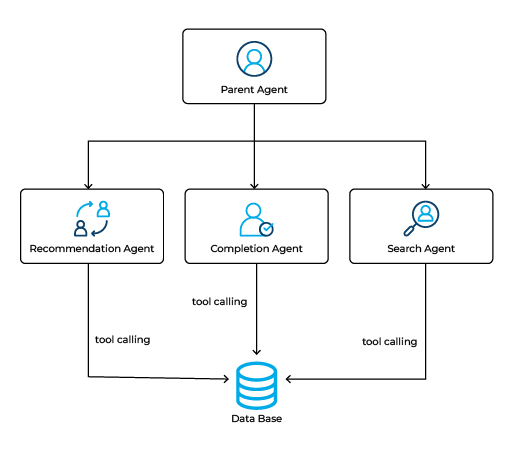
The system is composed of four main agents.
1. Parent Agent: The Orchestrator
- Acts as the entry point for all incoming user requests
- Performs intent classification and task routing
- Delegates work to specialized sub-agents
- Handles re-delegation or fallback responses when needed
The Parent Agent’s logic functions like a router combined with a context analyzer, determining which sub-agent should take ownership of the request.
2. Recommendation Agent: Contextual Insights
This agent specializes in generating context-based recommendations, such as suggesting items, actions, or next steps. It uses internal reasoning along with a custom-built tool that retrieves relevant data from the database to generate informed suggestions.
Example use cases:
- “Show me trending items.”
- “What are the top-rated restaurants nearby?”
3. Search Agent: Information Retrieval
This agent functions as a retrieval pipeline, focusing exclusively on fetching structured data with high precision using database-integrated search tools.
Example queries:
- “Find restaurant details by city.”
- “Get all entries with a five-star rating.”
4. Completion Agent: Task Executor
The Completion Agent is responsible for executing create, update, and completion-based tasks. Whenever a query involves action rather than retrieval, like inserting or updating data, the Parent Agent delegates it to this agent.
Example tasks:
- “Add this restaurant to the database.”
- “Update the dish price.”
Workflow: Intelligent Delegation
Here’s how a request moves through the system:
- Request Entry – All requests are submitted through the Parent Agent.
- Intent Classification – The Parent Agent analyzes intent using reasoning or classification logic.
- Delegation – It assigns the task to the appropriate sub-agent.
- Execution – The selected sub-agent performs the task using its specific toolset.
- Re-routing – If a request falls outside a sub-agent’s scope, it is escalated back to the parent agent.
- Fallback – If no suitable agent exists, the Parent Agent provides a default response.
This process ensures autonomy, modularity, and fault tolerance, enabling the system to adapt dynamically to the context of each request.
Tooling Layer: Data Access and Actions
Each sub-agent has access to custom tools that interact directly with the backend database.
Common operations include:
- Data retrieval (
get,findByField, etc.) - Data modification (
insert,update, anddelete) - Validation and error handling
These tools enable agents to perform real operations rather than just generate text.
For example:
“Add a new restaurant to the list.”
The Parent Agent identifies it as a task completion request, delegates it to the Completion Agent, which triggers the database insertion tool, and returns a confirmation message.
Why Multi-Agent Design?
The multi-agent approach offers several engineering benefits:
- Modularity: Each agent focuses on a specific domain, simplifying debugging and scaling
- Reusability: Agents can be reused or extended across different applications
- Scalability: New agents can be integrated without disturbing existing logic
- Context Isolation: Each agent handles its domain-specific tasks, improving accuracy and reducing confusion
Compared to a single monolithic agent, this design allows for better adaptability, maintainability, and distributed reasoning.
Key Notes
Implementing this architecture with Google’s Agent Development Kit highlighted how structured delegation transforms conversational AI into a cooperative, context-aware framework. Instead of one model doing everything, we now design ecosystems of intelligent agents that collaborate effectively, much like distributed microservices in a backend architecture.
The result is a system that is:
- Autonomous
- Modular
- Scalable
- Context-aware
Conclusion
As AI continues to evolve, the distinction between “chatbots” and “autonomous systems” is fading. The true challenge now lies in orchestrating intelligence by designing agents that can reason, delegate, and cooperate efficiently. By combining modular architectures with tools like Google’s Agent Development Kit, we are moving toward the era of composable AI systems, where intelligence is not centralized but distributed, dynamic, and domain-aware.