
Serverless Backend Development with AWS Lambda and Azure Functions
In traditional backend development, teams spend significant time managing servers, configuring environments, monitoring performance, and handling scaling as traffic changes. These responsibilities often slow development and divert attention from building meaningful product features. As applications grow, infrastructure becomes harder to manage and increases operational overhead.
Serverless computing changes this model by moving infrastructure management to the cloud provider and allowing developers to focus entirely on writing code. Functions run in response to events, scale automatically, and incur cost only when they execute. Platforms like AWS Lambda and Azure Functions make this approach practical and reliable for modern backend development.
What Are AWS Lambda and Azure Functions?
AWS Lambda and Azure Functions are serverless compute services provided by Amazon and Microsoft. They enable developers to execute small, independent functions without managing servers.
- AWS Lambda allows developers to upload code that runs in response to events from AWS services or external sources. AWS automatically handles execution, scaling, and infrastructure management
- Azure Functions offers similar functionality on the Azure platform. Functions can be triggered by HTTP requests, database changes, queue messages, or timers
Both platforms support automatic scaling, event-driven execution, and a pay-per-use pricing model where charges apply only to the resources consumed during execution.
How Does Serverless Computing Work?
In a traditional setup, servers must always be running to handle requests, even during low traffic. This leads to higher costs and ongoing maintenance. Serverless computing executes code only when an event occurs. Functions are short-lived, stateless, and fully managed by the cloud provider, which handles scaling, availability, and fault tolerance.
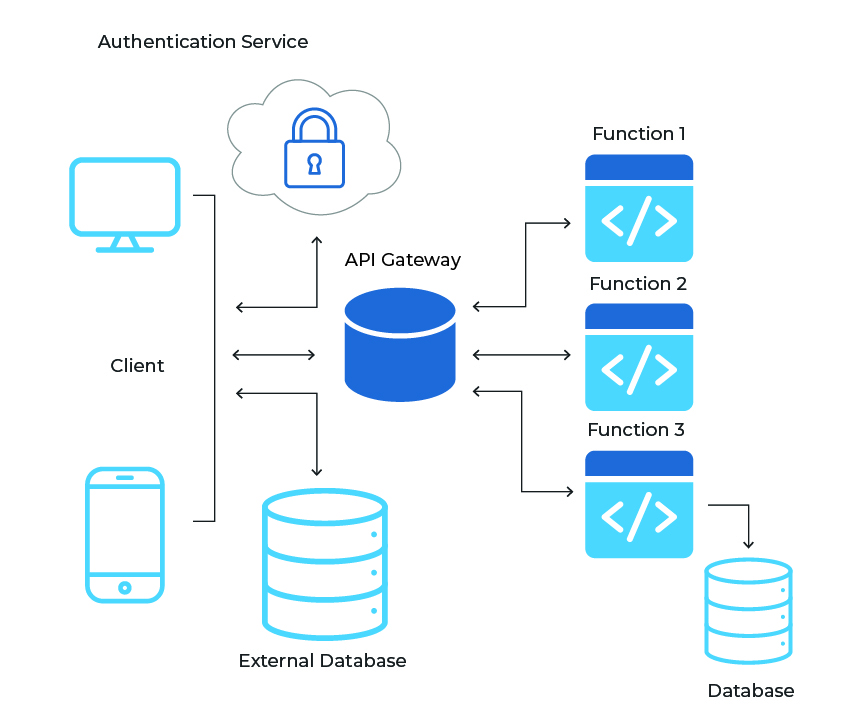
Example of Serverless Architecture:
Consider an application where users upload images:
- Event: A user uploads an image
- Trigger: The upload triggers a serverless function
- Function: The function resizes the image
-
Result: The resized image is stored, and the user is notified
The function runs only when needed, scales automatically, and requires no infrastructure management.
Steps to Build a Serverless Backend with AWS Lambda and Azure Functions
Building with AWS Lambda:
1. Create an AWS Account
If you do not already have one, sign up for an AWS account.
2. Write the Lambda Function Code
AWS Lambda supports multiple programming languages, including Node.js, Python, Java, Go, and C#. For example, let’s write a simple function in Node.js.
Example code (Node.js):
3. Create the Lambda Function
In the AWS Management Console:
- Navigate to the Lambda service
- Click on the Create function
- Choose the function name and runtime (Node.js, Python, etc.)
- Upload your code
4. Set Up API Gateway
To make your Lambda function accessible via HTTP requests, integrate it with Amazon API Gateway by creating a REST API and linking it to the Lambda function.
5. Deploy and Test
Once the function and API Gateway are set up, deploy the function and test it by invoking the API endpoint.
Building with Azure Functions:
1. Create an Azure Account
If you do not already have one, sign up for an Azure Account.
2. Write the Function Code
Azure Functions supports multiple programming languages such as C#, Node.js, Python, Java, and PowerShell.
Example code (Node.js):
3. Create the Azure Function
Create a new function app through the Azure portal or CLI. Select the trigger type, such as an HTTP trigger, and add your code.
4. Set Up API Management (Optional)
For exposing your functions as REST APIs, integrate them with Azure API Management or directly invoke them using the HTTP trigger.
5. Deploy and Test
Once the function is ready, deploy it and test using the function URL or Azure API Management.
Key Benefits of Serverless Backend Development
- No Server Management: Infrastructure provisioning and scaling are handled by the cloud provider
- Cost Efficiency: You pay only for execution time, making it suitable for variable workloads
- Automatic Scaling: Functions scale seamlessly based on demand
- Faster Development: Reduced setup time enables quicker development and deployment
Challenges of Serverless Backend Development
- Cold Starts: Infrequently used functions may experience startup delays
- Execution Limits: AWS Lambda (up to 15 minutes) and Azure Functions (5 minutes by default) limit long-running tasks
- Statelessness: Functions do not retain state between executions and require external storage
- Vendor Lock-in: Strong dependency on cloud-specific services can complicate migration
Best Practices for Serverless Backend Development
- Optimize cold starts by using lightweight runtimes
- Keep functions short and focused
- Secure access using IAM roles or Managed Identities
- Store secrets in environment variables or secret management services
-
Monitor performance using CloudWatch or Application Insights
Conclusion
Serverless backend development with AWS Lambda and Azure Functions is becoming a practical foundation for how backend systems will be built going forward. As cloud services continue to improve, this approach allows teams to reduce time spent on infrastructure decisions and concentrate on building stable, responsive application logic.
Although challenges such as cold starts, execution limits, and stateless design still require careful planning, these constraints are becoming easier to manage with experience and better platform support. Teams that adopt serverless with thoughtful design and clear boundaries will be well-equipped to build backend systems that can grow and adapt over time.