
Introduction
Modern distributed systems rely on many independent services that must communicate reliably. As applications become more modular, direct service-to-service communication introduces fragility. Network delays, partial failures, and uneven traffic patterns make synchronous integration increasingly difficult to manage.
RabbitMQ addresses these challenges by acting as an intermediary between software components. Instead of relying on direct connections, services exchange messages through queues and exchanges. This messaging approach allows producers and consumers to operate independently while maintaining controlled communication across distributed systems.
What Is RabbitMQ?
RabbitMQ is an open-source message broker that routes messages between different software components using queues and exchanges. By introducing a dedicated messaging layer, it separates message producers from consumers and removes the need for direct runtime dependencies.
As a result, applications can continue to exchange data even when certain services are unavailable or processing workloads at different speeds. This decoupled communication model supports asynchronous processing, background tasks, and event-based workflows without compromising system stability.
How Message Flow Works in RabbitMQ
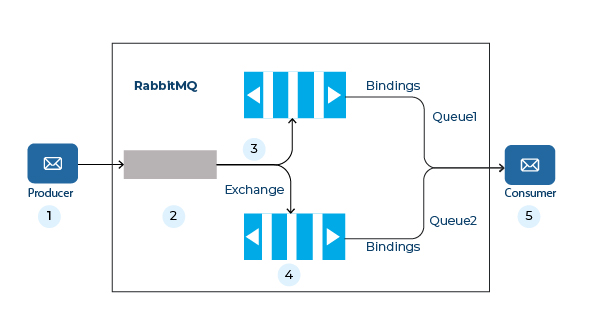
To understand how RabbitMQ manages communication, it is helpful to examine the message flow. Each message follows a structured path that the broker controls from start to finish.
- A producer sends a message to RabbitMQ through a channel
- The message is received by an exchange
- The exchange evaluates routing rules
- The message is placed into one or more queues
- Consumers retrieve messages from queues and process them
Because producers interact only with exchanges and consumers interact only with queues, services remain loosely coupled while message delivery remains predictable.
Why Message Brokers Matter in Modern Application Development?
Traditional monolithic applications are being replaced by microservices. While this approach improves flexibility, it also introduces communication challenges such as:
- Network delays
- Service failures
- High traffic loads
- Complex dependencies
Message brokers like RabbitMQ address these issues by enabling asynchronous communication.
Key Benefits
- Decoupling Services: Producers and consumers operate independently
- Scalability: Services can scale without affecting others
- Reliability: Messages are stored until successfully processed
- Resilience: Failures in one service do not break the system
- Traffic Management: Queues help handle sudden spikes
Because of these advantages, message brokers have become a standard part of modern architectures.
Current Industry Trends Driving the Need for RabbitMQ
Several technology trends are increasing the need for robust messaging systems:
- Growth of microservices architectures
- Adoption of event-driven design
- Real-time data processing
- Cloud-native and serverless platforms
- IoT and edge computing
RabbitMQ fits naturally into these scenarios by providing reliable and flexible asynchronous messaging.
Why RabbitMQ? Key Advantages Over Other Message Brokers
Although many messaging platforms exist, RabbitMQ remains one of the most widely used due to its versatility and maturity.
1. Protocol Flexibility
RabbitMQ supports multiple protocols such as:
- AMQP
- MQTT
- STOMP
- HTTP
This makes it suitable for use cases ranging from IoT to enterprise integration.
AMQP 0–9–1 and Message Framing in RabbitMQ
RabbitMQ uses AMQP 0–9–1 (Advanced Message Queuing Protocol) as its core messaging protocol. AMQP is an application-layer protocol that enables reliable communication between client applications (producers/consumers) and messaging brokers like RabbitMQ.
Unlike text-based protocols such as HTTP and REST, AMQP is a binary protocol, which makes it:
- Faster
- More compact
- Well-suited for high-throughput messaging systems
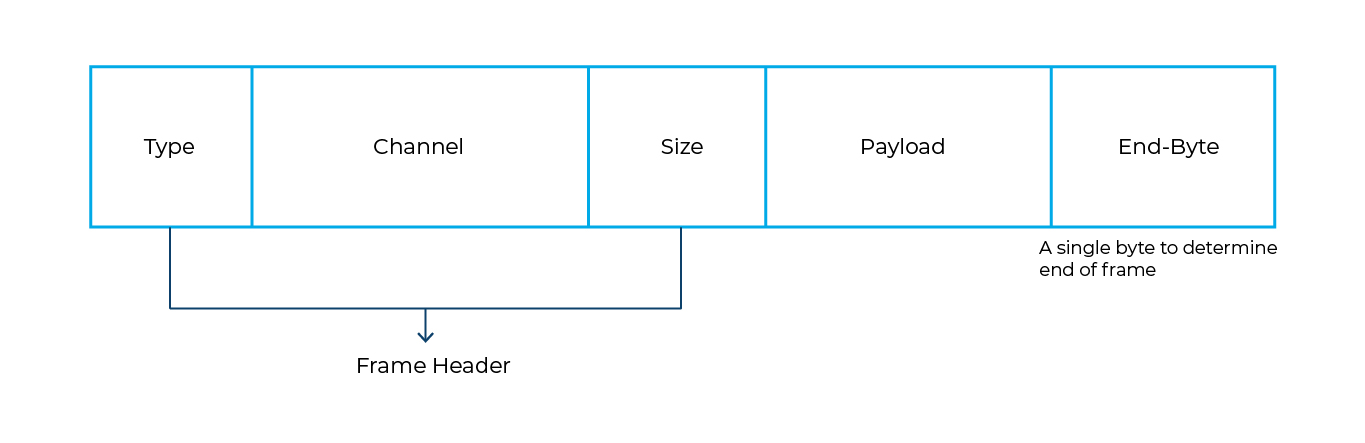
In AMQP, all data is transmitted as frames. A frame is the smallest unit of data exchanged between an AMQP client and the broker. Large messages are broken down into multiple frames and reassembled on the receiving side.
Each AMQP frame consists of:
- A frame header
- A payload
- An end byte
2. Advanced Routing with Exchanges
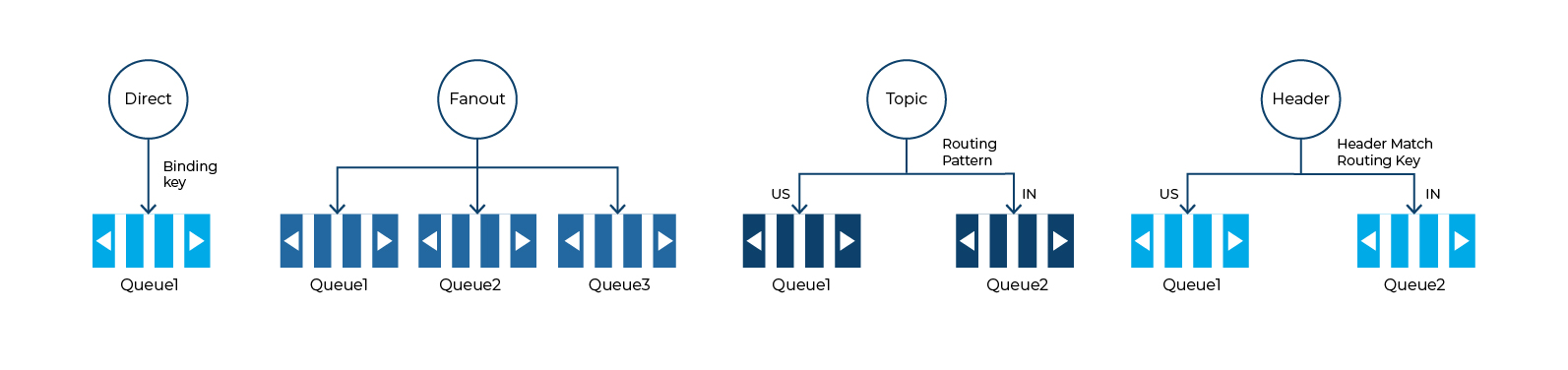
RabbitMQ’s direct, topic, fanout, and headers exchanges enable sophisticated message routing.
Types of Exchanges in RabbitMQ
- Direct Exchange: Routes messages based on an exact routing key
- Fanout Exchange: Sends messages to all bound queues
- Topic Exchange: Routes messages using wildcard patterns
- Headers Exchange: Routes messages based on message headers
These exchange types allow developers to implement complex messaging patterns with ease.
3. Strong Reliability and Persistence
RabbitMQ ensures message safety through:
- Message acknowledgments
- Durable queues
- Persistent messages
- Dead-letter exchanges
These features help ensure that important data is not lost.
4. High Availability and Clustering
RabbitMQ clusters provide:
- Automatic failover
- Mirrored queues
- Consistent and highly available messaging
This makes RabbitMQ suitable for production-grade enterprise workloads.
5. Mature Ecosystem and Management Tools
RabbitMQ includes:
- A powerful web-based management UI
- Plugins for monitoring, authentication, and federation
- Integration with most programming languages
How Many Message Brokers Exist Today?
Messaging platforms can be broadly grouped into four categories:
1. Traditional Message Brokers
- RabbitMQ
- ActiveMQ
- IBM MQ
- Azure Service Bus
2. Streaming Platforms
- Apache Kafka
- Redpanda
- Amazon Kinesis
3. Cloud-Native Messaging
- AWS SQS and SNS
- Google Pub/Sub
- Azure Event Hubs
4. IoT-Focused Brokers
- Mosquitto
- EMQX
Among these options, RabbitMQ stands out for its balance of flexibility, stability, and ease of use.
Why RabbitMQ Stands Out
RabbitMQ remains a top choice for enterprises because:
- It is protocol-agnostic
- Its routing flexibility surpasses most brokers
- It is easy to deploy, monitor, and scale
- It fits both traditional and cloud-native architectures
- It supports both work queues and publish-subscribe patterns
- It is backed by over a decade of community and enterprise adoption
From e-commerce platforms to banking systems, from IoT networks to large-scale microservices, RabbitMQ is a proven and reliable messaging backbone.
Conclusion
RabbitMQ has secured its position as one of the most dependable and versatile message brokers in modern application development. As organizations continue to adopt microservices, real-time processing, and cloud-native infrastructures, RabbitMQ provides the stability, scalability, and flexibility needed to ensure seamless communication across distributed environments.
Whether you are building event-driven applications, scaling backend systems, or designing enterprise-grade architectures, RabbitMQ offers the reliability, routing intelligence, and protocol support necessary for success in modern distributed systems.