How Snowflake AI Data Cloud Powers Enterprise AI Innovation
Enterprises are operating in a landscape defined by the proliferation of explosive data, accelerated AI adoption, and rising pressure to unify analytics, engineering, and application development. In this environment, Snowflake AI Data Cloud provides a unified approach, as legacy, siloed architectures spanning warehouses, lakes, ETL pipelines, ML platforms, and disparate application stacks can no longer deliver the agility, governance, or scale required for modern digital operations.
As a result, Snowflake’s AI Data Cloud has emerged as a transformative answer to this challenge. Evolving from a cloud-native data warehouse into a fully converged data, AI, and application platform, Snowflake enables organizations to build end-to-end solutions without moving data across disparate systems. This unified architecture dramatically simplifies operations, accelerates innovation, and ensures enterprise-grade governance.
A Unified Foundation: The Core Data Platform
Use Cases
- Consolidated enterprise data warehousing
- Data lake modernization and unification
- Real-time analytics and reporting
- Cross-cloud data collaboration and disaster recovery
Data Engineering and Processing: The Operational Backbone
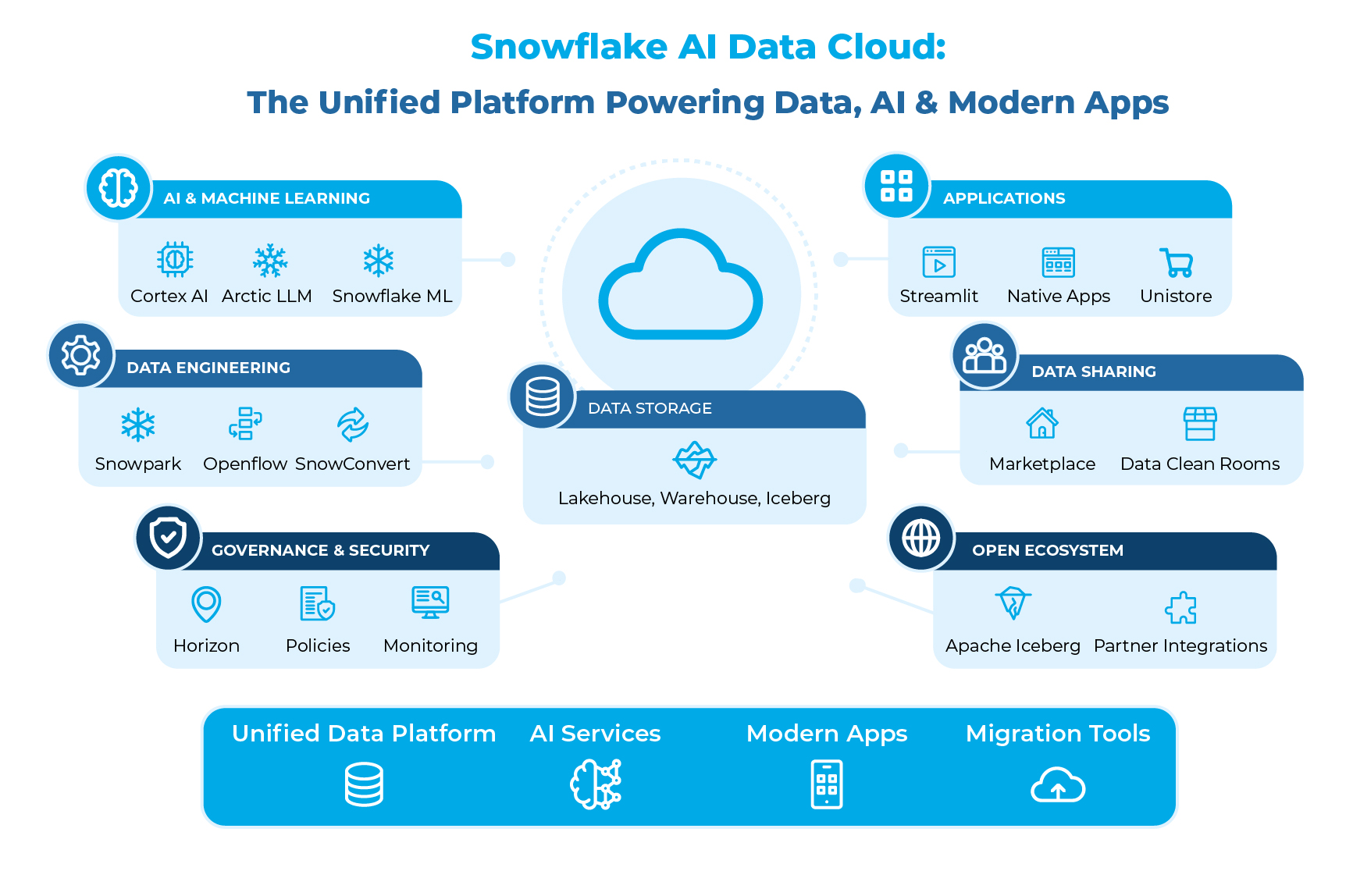
Snowflake provides a robust ecosystem for ingesting, transforming, and orchestrating data pipelines at scale. Snowpipe enables continuous event-driven ingestion for real-time data streams. Streams and Tasks support change data capture (CDC) and workflow automation, enabling the creation of incremental and efficient pipelines. A key advancement is that OpenFlow delivers batch and streaming pipelines, end-to-end lineage, and deep observability, extending beyond traditional ETL capabilities. Snowpark enables Python, Java, and Scala processing directly within Snowflake, eliminating data movement and improving efficiency.
Use Cases
- Flexible ETL/ELT pipelines
- Real-time ingestion and transformation
- Replacement of legacy integration tools (Informatica, Talend, Alteryx, etc.)
- In-database processing for performance and governance
AI and Generative AI: Snowflake’s Strategic Differentiator
Snowflake’s AI-native platform is powered by Cortex AI, which delivers LLM-driven capabilities such as text generation, summarization, sentiment analysis, embeddings, and semantic search through SQL or Python. Complementing these capabilities, Arctic, Snowflake’s open enterprise-grade LLM, enables secure, cost-efficient AI application development within the platform. Snowflake CoWork (formerly Snowflake Intelligence) operates as an AI-powered personal work agent that helps knowledge workers securely analyze business data, automate routine tasks, and execute actions across everyday workplace apps (like Slack, Jira and Gmail) using plain, conversational language. Additionally, Cortex Code (CoCo) introduces AI-assisted development to accelerate pipeline creation, transformation logic, and application development.
Use Cases
- Enterprise chatbots grounded in internal data
- Automated document processing and summarization
- AI-powered analytics and insights
- Custom LLM applications with full governance
- Automate routine tasks and execute actions across everyday workplace apps
Machine Learning and Data Science: End-to-End Within Snowflake
Snowflake provides a fully integrated machine learning ecosystem that eliminates the need for external ML platforms. Additionally, Snowflake ML supports feature engineering, model training, deployment, and lifecycle governance. Furthermore, Snowflake Notebooks offer a collaborative, Jupyter-style Workspace for experimentation, visualization, and model development, all running natively within the platform. Consequently, organizations can keep data, features, and models in a single environment, reducing latency, enhancing security, and simplifying MLOps.
Use Cases
- Predictive analytics and forecasting
- Fraud detection and risk scoring
- Customer segmentation and personalization
- Full MLOps lifecycle management
Application Development: From Data to Experience
Snowflake extends beyond analytics into application development with Streamlit in Snowflake, enabling interactive Python-based apps to run directly within the platform. Moreover, the Native App Framework allows organizations to build, deploy, and monetize applications through the Snowflake Marketplace. Meanwhile, Snowsight provides a unified workspace for analytics and management, while SnowSQL supports automation and CLI-driven workflows.
Use Cases
- Internal dashboards and operational tools
- AI-powered data applications
- SaaS products built natively on Snowflake
- Cross-team collaboration and rapid prototyping
Transactional and Hybrid Workloads: Unistore
With Unistore, Snowflake introduces hybrid tables that support transactional (OLTP) and analytical (OLAP) workloads in a single platform. As a result, organizations can eliminate the traditional divide between operational databases and analytical systems.
Use Cases
- Real-time applications (e-commerce, fintech)
- Unified operational and analytical workloads
- Live operational dashboards
Data Sharing, Collaboration, and Marketplace
Snowflake’s secure Data Sharing allows organizations to share live data across accounts without copying it. The Snowflake Marketplace expands this capability by enabling the exchange and monetization of datasets and applications. Furthermore, Data Clean Rooms provide privacy-preserving collaboration environments for sensitive data, enabling joint analytics without exposing raw information.
Use Cases
- Partner and vendor data collaboration
- Data product monetization
- Privacy-safe analytics in regulated industries
Governance, Security, and Observability
Snowflake’s Governance Framework, Horizon, provides comprehensive capabilities for data discovery, classification, lineage, and access control. Security features include RBAC, dynamic data masking, encryption, and fine-grained access policies. Moreover, Snowflake’s observability tools support monitoring of pipelines, usage, and AI model performance.
Use Cases
- Regulatory compliance (HIPAA, GDPR, PCI)
- Enterprise data governance and access control
- Pipeline and model observability
Open Ecosystem and Interoperability
Snowflake embraces openness by supporting Apache Iceberg and Polaris, its open catalog initiative. As a result, organizations can leverage interoperability with engines like Spark, Trino, and Presto. Snowflake integrates seamlessly with dbt, Airflow, and leading BI platforms, making it a central hub in modern data architectures.
Use Cases
- Multi-engine data architectures
- Avoiding vendor lock-in
- Integrating existing data and AI tools
Migration and Modernization
SnowConvert, Snowflake’s AI-powered migration tool, accelerates the conversion of legacy SQL and ETL code into Snowflake-native formats, reducing modernization risks and efforts.
Use Cases
- Migrating from Oracle, Teradata, Netezza, etc.
- Modernizing legacy warehouses
- Accelerating cloud adoption
Conclusion: A Converged Platform for the AI Era
Snowflake’s AI Data Cloud represents a fundamental shift in how enterprises manage data, build AI, and deliver applications. By unifying storage, compute, AI, ML, governance, and application development into a single platform, Snowflake eliminates architectural complexity and unlocks new levels of agility and innovation. With capabilities spanning Snowpark, Cortex AI, Snowflake ML, Streamlit, Unistore, OpenFlow, CoCo, CoWork, Polaris, and Horizon, Snowflake offers a cohesive ecosystem where data, intelligence, and applications converge securely, scalably, and efficiently. Ultimately, for organizations navigating the complexities of modern data and AI, Snowflake offers a compelling vision: a unified, AI-native platform built for the future.