
How Does WebSocket Performance Optimization Improve Real-Time AI Communication?
Artificial Intelligence is evolving beyond text, enabling real-time conversations through virtual assistants, customer support bots, and AI tutors. As users expect natural, immediate responses, communication delays can make even advanced AI interactions feel slow and unnatural. While model performance often gets the most attention, the communication layer is equally important in real-time AI applications. WebSocket Optimization enables persistent, bidirectional communication, but delivering smooth, human-like interactions requires optimizing data transmission, processing, and network performance.
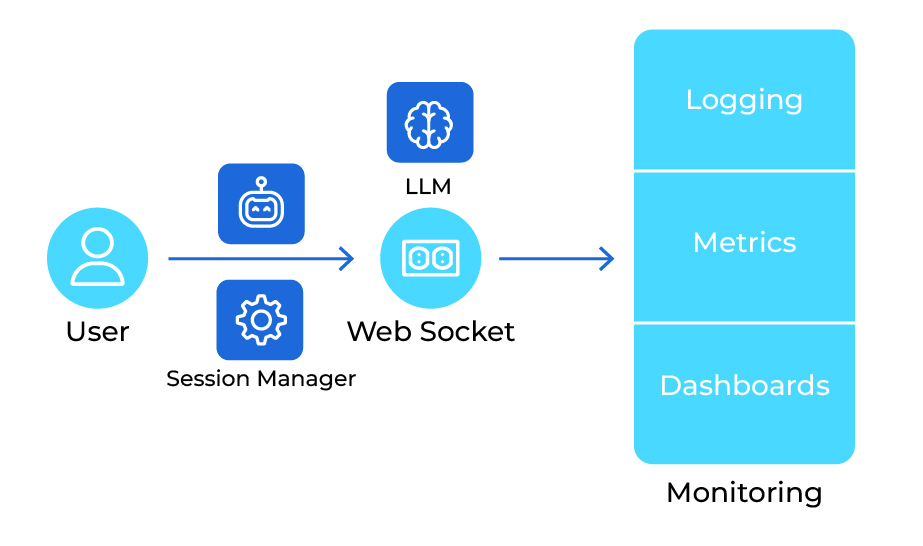
The Challenge of Real-Time AI Communication
Traditional web applications rely on request-and-response patterns. Real-time AI systems operate differently and require an efficient Real-time communication architecture. They exchange data continuously, including audio streams, transcripts, generated tokens, and control signals.
Latency Accumulation
Every stage in the communication pipeline contributes to latency. Audio capture, serialization, network transmission, AI inference, and playback each add a small delay. Individually, these delays may seem insignificant, but together they can noticeably impact the user experience.
Protocol Overhead
Many applications use JSON to exchange messages because it is easy to read and debug. However, JSON can add overhead for real-time streaming workloads. Larger messages and repeated parsing operations increase processing time and network usage.
Backpressure
AI systems often generate data faster than clients can consume it. For example, a voice assistant may continuously stream generated audio while the user’s device struggles to process incoming packets. Without proper controls, this results in growing buffers and delayed playback.
Network Jitter
Internet connections are rarely perfect. Variations in packet arrival times can lead to inconsistent audio playback, making voices sound robotic or fragmented. For conversational AI, these disruptions can reduce the quality of interaction.
Key Optimizations for WebSocket Performance
To overcome these challenges, developers should treat WebSockets as a persistent communication layer, not just a messaging channel.
Adopt Binary Serialization
Binary formats such as Protobuf, MessagePack, and FlatBuffers can reduce payload sizes and processing overhead compared with JSON, depending on the data structure and implementation. This can improve transmission speed and help minimize latency in real-time AI applications.
Benefits include:
- Faster message processing
- Reduced network traffic
- Lower CPU utilization
For applications streaming thousands of audio packets, these improvements can help reduce overall delays.
Implement Flow Control
Flow control helps manage data flow between the server and client, preventing buffer buildup and delays. By sending only the amount of data a client can process, applications can maintain smoother and more responsive real-time interactions.
This approach helps:
- Prevent buffer accumulation
- Reduce playback delays
- Maintain synchronization between client and server
- Improve responsiveness during interruptions
Effective flow control is especially important in voice applications where even small delays can negatively impact the conversational experience.
Optimize Connection Management
Persistent WebSocket connections avoid repeated handshakes and support continuous data transfer. Efficient session management further enhances performance and reliability in real-time AI systems.
Use Edge Infrastructure
Deploying edge infrastructure helps reduce network latency by processing requests closer to users. Technologies such as edge gateways, regional AI clusters, and Anycast routing improve response times and enhance the AI experience.
Modern architectures often combine:
- Edge gateways
- Regional AI clusters
- Anycast routing
- Layer 4 load balancing
By processing requests closer to users, organizations can reduce round-trip times and improve responsiveness.
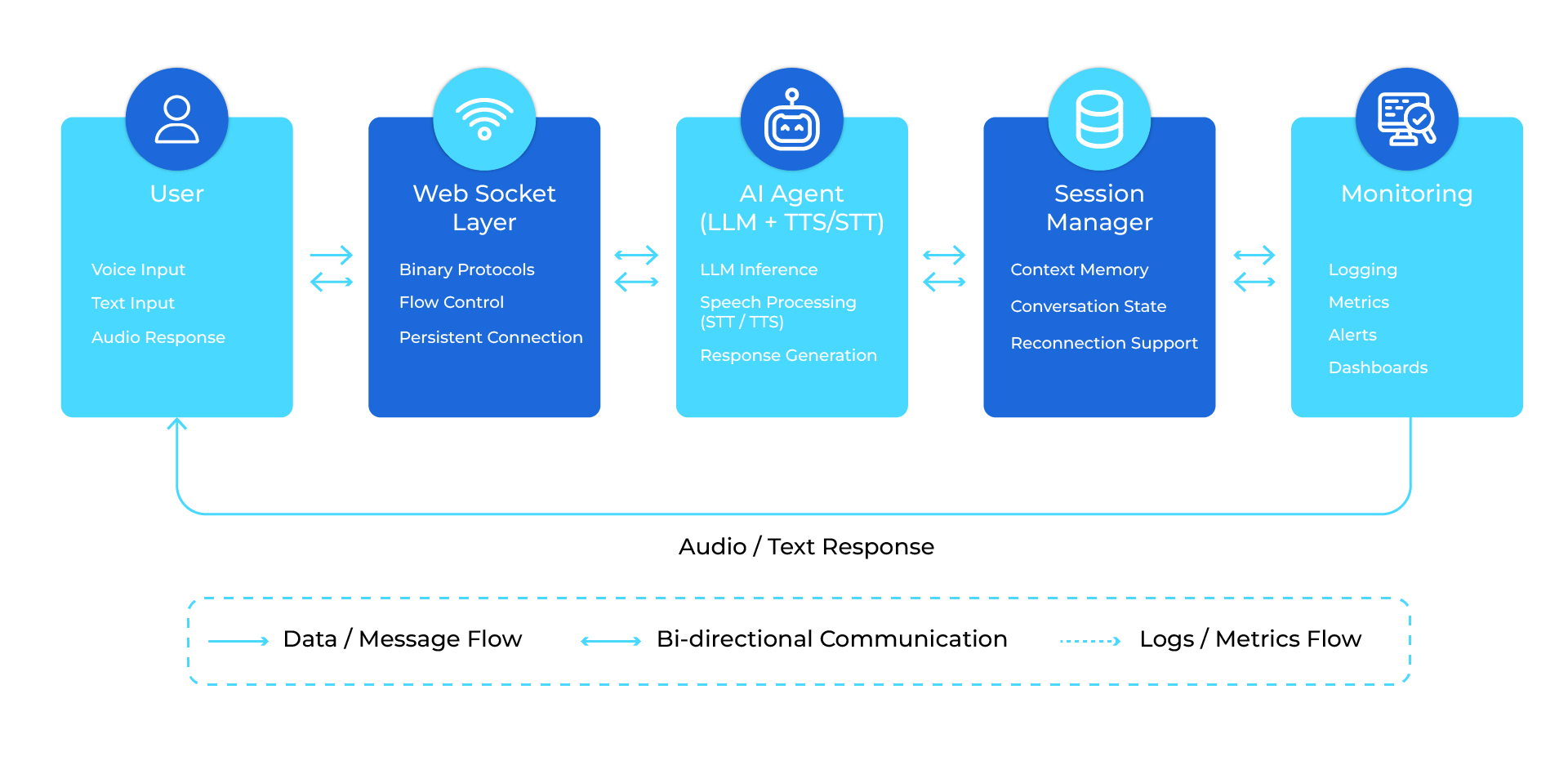
Real-World Example: Handling User Interruptions
Consider a voice-based AI assistant interacting with a customer through modern AI chatbot applications. While the AI is speaking, the user interrupts with another question. In a poorly optimized system, the assistant continues playing its queued audio before processing the new input, forcing the user to wait and making the conversation feel slow and unnatural.
In an optimized architecture, the client immediately sends a brief control message through the WebSocket connection. The server receives the signal, clears any pending audio, and switches the AI back into listening mode. This allows the assistant to respond naturally to interruptions, creating a smoother and more human-like conversational experience.
Best Practices for Real-Time AI Applications
Several practical techniques can further improve WebSocket performance.
- Use TLS 1.3: Security should never come at the expense of speed. TLS 1.3 reduces the number of round trips required during connection establishment, enabling faster secure connections.
- Implement Jitter Buffers: Small client-side jitter buffers can smooth inconsistent packet delivery while limiting added delay. The required buffer size depends on network conditions and application requirements.
- Enable Heartbeats: Periodic heartbeat messages help detect inactive connections and support connection monitoring. This is particularly important for long-running conversations.
- Support Session Recovery: Network interruptions are inevitable. Applications should allow users to reconnect and restore the session state to preserve conversation context. This helps improve reliability and user experience.
- Monitor Performance Metrics: Track round-trip time (RTT), message processing latency, audio generation time, buffer utilization, and connection stability to identify bottlenecks and maintain consistent performance through AI application performance monitoring.
Measuring the Impact
The benefits of WebSocket optimization can be substantial.
|
Optimization |
Potential Improvement |
|
Binary Serialization |
Smaller payloads and reduced processing overhead |
|
Edge Routing |
Lower network latency |
|
Persistent Connections |
Reduced handshake overhead |
|
Flow Control |
Less audio buffering |
|
Jitter Buffers |
Smoother audio playback |
While actual results depend on network conditions and application architecture, these optimizations help create a faster, more natural user experience.
Conclusion
As AI evolves toward real-time, multimodal interactions, communication performance becomes just as important as model intelligence. Users expect AI agents to respond quickly and naturally, making low-latency communication a key factor in delivering high-quality experiences.
WebSockets provide the foundation for real-time AI communication, but achieving optimal performance requires techniques such as binary serialization, flow control, persistent connections, and efficient session management. By optimizing the communication layer alongside model performance, developers can build AI agents that feel more responsive, conversational, and human-like.