
How Can AIOps Improve GenAI Application Operations?
Artificial Intelligence is changing how modern applications are designed, developed, and operated. Businesses are increasingly adopting Large Language Models (LLMs), AI agents, Retrieval-Augmented Generation (RAG), and orchestration frameworks to build intelligent applications. However, building and deploying an AI application is only part of the challenge. Organizations also need to monitor these systems for performance, reliability, security, behavior, and cost once they are in production. This is where AIOps is emerging as an important operational layer for managing and optimizing modern AI systems.
The Shift from Traditional Monitoring to AI Control
In conventional systems, observability focused on CPU and memory usage, API latency, infrastructure health, error logs, incidents, and service uptime. These metrics worked well for applications with relatively predictable execution patterns. Generative AI systems introduce additional complexity through variable outputs, token consumption, model behavior, and dynamic workflows.
An LLM application may generate inaccurate or unsafe responses or trigger complex multi-agent workflows, making issues difficult to trace. Teams need to understand which prompt contributed to a quality issue, what caused token usage to increase, which workflow contributed to latency, or where an agent failed. Traditional infrastructure monitoring alone does not provide this level of AI-specific visibility, creating a need for specialized observability and operational capabilities.
Why Modern GenAI Systems Need Intelligent Operations
Modern AI applications are more than simple chatbots. Enterprise GenAI systems combine LLMs, vector databases, RAG, prompt pipelines, AI agents, memory, external APIs, and feedback loops, increasing operational complexity. Frameworks such as LangChain and LangGraph simplify development, but managing larger, dynamic workflows remains challenging.
A single request can involve prompt processing, context retrieval, tool execution, agent reasoning, and response generation. Without visibility across these stages, teams may struggle to trace failures, debug issues, and optimize performance. AIOps provides the visibility needed to monitor AI workflows, understand system behavior, and maintain reliable performance in production as applications grow.
AIOps as the Control Layer for GenAI
The role of AIOps is moving toward intelligent operational control and visibility across the complete AI lifecycle. Instead of simply collecting logs, modern AIOps platforms need to understand prompts, costs, workflows, and governance.
1. Prompt Traceability
Prompt engineering is becoming a key configuration layer for AI applications. Even small prompt changes can affect output quality, safety, latency, cost, and hallucination rates. AIOps can track prompt versions, changes, user interactions, and response quality to identify issues and understand their impact on system reliability.
2. Cost Monitoring and Optimization
GenAI costs vary based on input and output tokens, context size, retrieval frequency, and agent execution depth. AIOps can track costs, support model selection, route requests based on complexity, and apply fallback strategies. Simple requests can use smaller models, while complex tasks can be routed to more capable models.
3. Workflow Visibility and Debugging
AI agents follow dynamic execution paths, making failures harder to identify. Frameworks such as LangGraph support branching agent workflows, increasing the need for detailed visibility. AIOps can provide execution tracing, workflow monitoring, latency tracking, agent interaction analysis, and failure detection to help teams understand how an AI system produced an output and where issues occurred.
4. Governance and Compliance
Organizations need controls for AI security, privacy, compliance, and responsible usage. AIOps can support governance through:
- Prompt audit trails
- Sensitive data detection
- Output moderation
- Policy enforcement
- Human approval workflows
These controls are particularly important in regulated industries such as healthcare, banking, and insurance, where data protection and compliance requirements are critical.
The Role of LangChain and LangGraph in AI Operations
Frameworks such as LangChain and LangGraph help organizations build advanced AI applications with greater speed and flexibility. LangChain connects prompts, memory, APIs, tools, and retrieval, while LangGraph supports stateful, agentic workflows. These dynamic architectures increase operational complexity, making AIOps essential for monitoring prompts, tracing workflows, analyzing latency, and understanding agent interactions and decisions.
Designing a Practical AIOps Architecture for GenAI
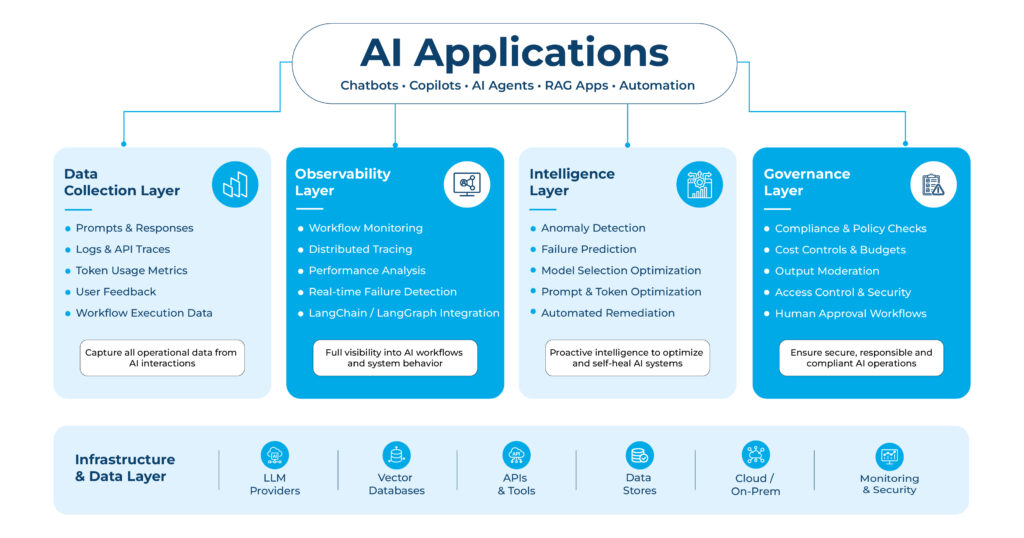
A practical AIOps architecture for Generative AI should be focused on visibility, automation, and governance. The Data Collection Layer captures prompts, responses, logs, token usage, user feedback, and API traces. The Observability Layer processes this data for workflow monitoring, distributed tracing, performance analysis, and real-time failure detection.
The Intelligence Layer enables proactive operations by detecting anomalies, predicting failures, optimizing model selection, and automating remediation. The Governance Layer supports secure and responsible AI operations through compliance checks, cost controls, output moderation, and human approvals. Together, these layers help organizations build reliable, scalable, and trustworthy GenAI applications.
The Future of AIOps in the GenAI Era
As AI systems become more autonomous and integrated into business operations, AIOps will play an increasingly important role in continuously monitoring AI behavior, optimizing costs, detecting issues, and maintaining governance. The future of AI operations extends beyond advanced models to flexible, reliable, transparent, and controllable systems. Organizations adopting GenAI at scale must invest in both AI development and robust operational architectures.
Conclusion
In the GenAI era, observability alone is no longer enough. Organizations need intelligent operational systems that can continuously monitor, govern, optimize, and control increasingly complex AI environments. AIOps provides this operational intelligence by connecting observability, automation, cost management, workflow monitoring, and governance to support reliable, adaptable, and controlled GenAI applications.