
How Does Agentic AI Improve QA Automation and Testing?
Software testing has evolved from manual execution to automation frameworks such as Selenium, Cypress, and Playwright, improving testing speed and consistency. Yet QA teams still spend significant time understanding requirements, designing scenarios, writing scripts, fixing flaky tests, and maintaining test suites as applications evolve. Generative AI has reduced some of this effort through code generation and test assistance, but many AI tools still rely on prompts rather than coordinating the testing lifecycle.
This is where Agentic AI changes the equation. Agentic AI introduces goal-driven agents that can act like QA collaborators, planning test strategies, generating automation code, executing tests, analyzing failures, and adapting to application changes with human oversight. This shifts AI from task assistance toward coordinated testing workflows
What Is Agentic AI?
Agentic AI is an AI paradigm where systems do more than generate responses. They can interpret high-level goals, break them into smaller tasks, make decisions during execution, use tools through standardized interfaces, adapt to results, and collaborate with specialized agents. In simple terms, Agentic AI shifts AI from responding to individual tasks to working toward broader goals and pursuing them with greater autonomy.
Core Characteristics of Agentic AI
1. Goal-Oriented Planning
Agentic systems start with the desired outcome rather than isolated commands. They break objectives into actionable tasks and plans.
2. Autonomous Decision-Making
During execution, agents respond to runtime conditions and make decisions instead of failing immediately when unexpected events occur.
3. Reasoning and Problem Solving
Agents analyze the causes of failures and determine appropriate corrective actions rather than simply reporting errors.
4. Continuous Adaptation
Agents can adapt their strategies as user interfaces, workflows, and system behavior change over time.
5. Multi-Agent Collaboration
Different agents can specialize in planning, test generation, execution, healing, and repository operations, working through a coordinated pipeline.
Agentic AI Across the QA Lifecycle
Agentic AI is most powerful when applied across the entire QA lifecycle, connecting activities from requirement analysis through continuous improvement.
Requirement Analysis
- Parses natural-language requirements
- Extracts business rules, dependencies, validations, and acceptance criteria
Test Planning and Scenario Design
- Generates functional, negative, boundary, and exception scenarios
- Identifies gaps beyond happy paths
Automated Test Generation
- Converts test scenarios into Playwright scripts
- Supports modular designs, reusable methods, assertions, and coding standards
- Produces framework-aligned test assets
Intelligent Test Execution
- Executes tests with runtime awareness
- Uses auto-waiting and analyzes unexpected behavior
- Collects detailed execution evidence
Self-Healing and Failure Analysis
- Repairs locator issues when validated
- Re-runs affected tests to verify repairs
- Analyzes failures to identify potential causes
Repository and Collaboration Workflows
- Creates authorized branches, commits, and pull requests
- Keeps test automation synchronized with product changes
Reporting and Continuous Improvement
- Produces actionable summaries rather than simple pass/fail results
- Supports root-cause analysis and trend visibility
- Enables faster prioritization and informed decision-making
Agentic AI in the QA LifeCycle
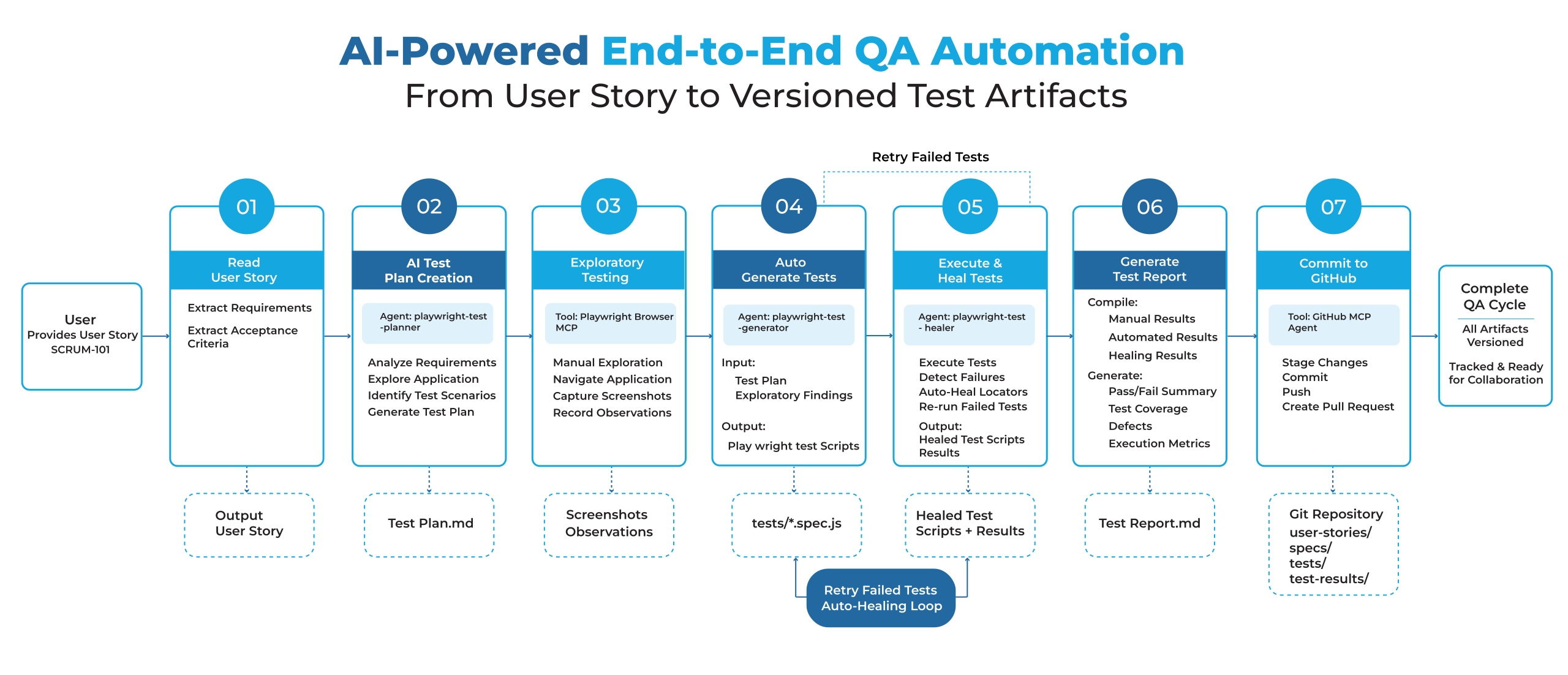
How AI Agents and MCP Servers Work Together
Large language models (LLMs) can reason and generate responses, but they need tools to interact with browsers, repositories, and files. The Model Context Protocol (MCP) standardizes how AI applications connect to external tools and context.
Why MCP Matters in QA Automation
MCP enables agents to move beyond generating responses and execute real testing tasks, such as interacting with browsers, accessing repositories, and managing files.
Typical Agent- MCP Interaction Pattern
- Planner agent defines the testing strategy
- Test-generation agent creates automation assets
- Execution agent runs tests through the browser and MCP services
- Healing agent analyzes failures and applies appropriate fixes
- Repository MCP services manage commits and pull requests
Benefits of Agentic AI in QA
Agentic AI delivers value across speed, quality, and scalability:
- Faster test design through natural-language-to-test conversion
- Broader coverage of negative, boundary, and edge cases
- Lower maintenance effort through validated test repairs
- Faster CI/CD feedback through automated test triage
- Better failure analysis through diagnostic evidence
- Seamless toolchain integration across testing and development systems
- Higher QA productivity by shifting effort from scripting to strategy
- Scalable testing operations through specialized multi-agent orchestration
Current Limitations and Challenges
Agentic AI is promising, but it comes with challenges. Teams should adopt it with clear governance, appropriate oversight, and realistic expectations.
Key Constraints to Consider
- Input Quality: Ambiguous requirements can reduce output quality
- Domain Context: Specialized business rules may be missed without proper grounding
- Human Oversight: AI outputs still require review for business accuracy
- Self-Healing Risks: A “working” fallback locator may not always reflect user intent
- Security and Access Control: Enforce permissions and audit autonomous actions.
- Integration Complexity: Enterprise environments require careful rollout and orchestration
- Cost and Infrastructure: Multi-agent execution and model usage require operational planning
Real-World Use Cases of Agentic AI in Testing
Agentic AI can support practical, recurring QA scenarios, including:
- Automated regression modernization with continuous test script adaptation
- Requirement-to-automation acceleration for faster sprint cycles
- Self-healing UI automation for frequently changing interfaces
- Continuous testing in CI/CD with faster analysis and feedback
- Cross-browser and platform testing through centralized orchestration
- Advanced failure analytics for quicker triage and informed release decisions
Conclusion
Software testing is entering a new phase where traditional automation remains essential, while Agentic AI extends its capabilities with autonomy, reasoning, adaptability, and intelligent tool-level execution. By combining autonomous agents, Playwright automation, and MCP-enabled integrations, QA teams can streamline test planning, execution, failure analysis, and maintenance while keeping humans in control of strategy, risk, and release confidence. Agentic AI is not replacing QA engineering; it is evolving it.