
How Do ReAct AI Agents Combine Reasoning and Action?
Artificial Intelligence is rapidly moving from static response systems to intelligent agents that can analyze situations, make decisions, and perform actions through connected tools and systems. ReAct Agents represent this shift by combining logical reasoning with tool-based action to create more adaptive AI solutions. The ReAct approach enables an AI model to reason about a task, take actions through external tools, observe the results, and use that information to decide the next step.
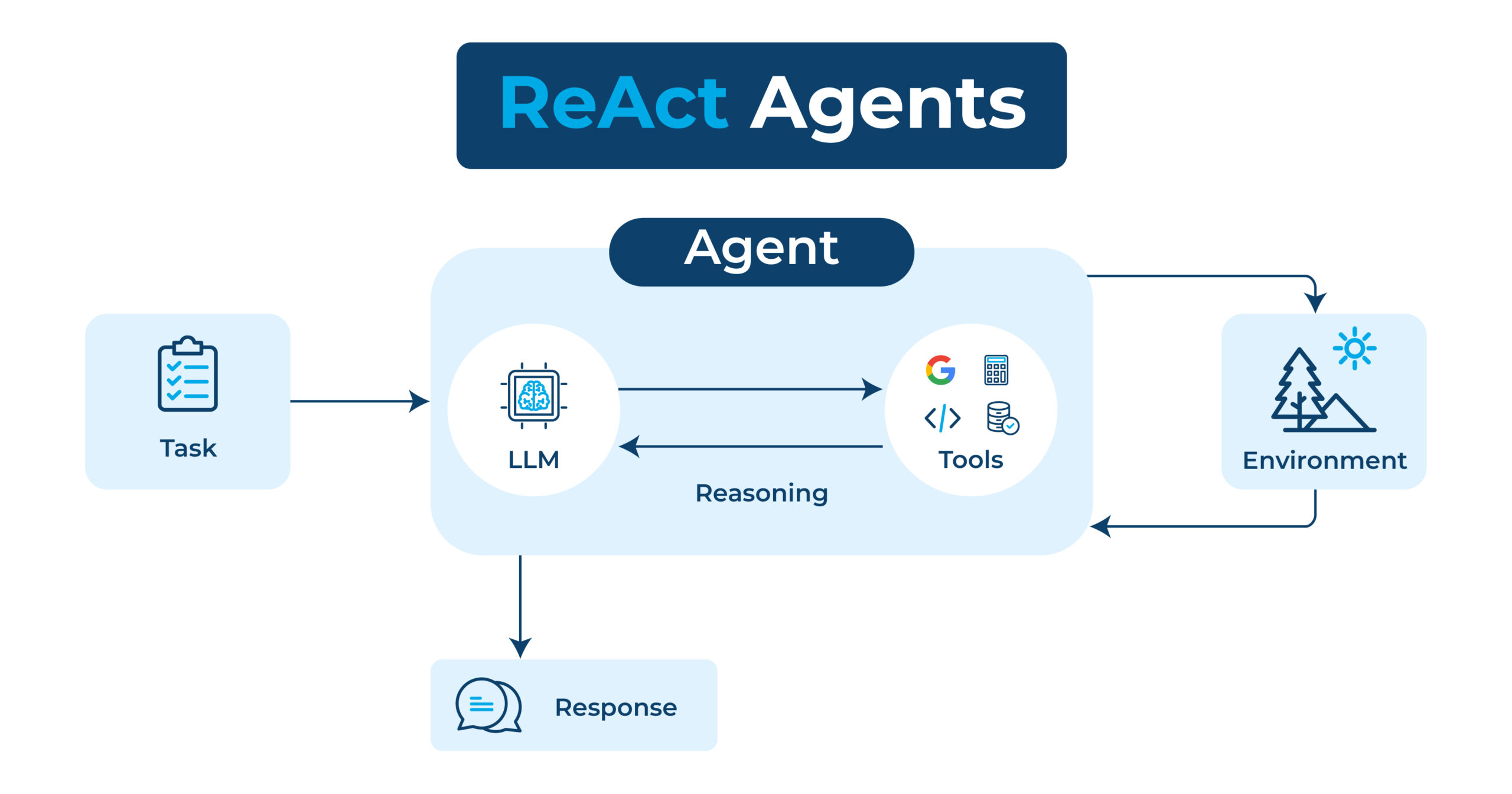
ReAct agents connect AI decision-making with practical task execution, enabling systems to respond intelligently while interacting with external tools, applications, and data sources.
What Makes ReAct Agents Different?
Traditional AI models typically work in a specific pattern:
Input → Prediction → Output
While effective for many use cases, this structure has limitations when dealing with dynamic or multi-step tasks. The model may lack access to current information, fail to verify assumptions, or struggle with complex reasoning that requires multiple steps or external data.
ReAct agents address these limitations by introducing an iterative workflow:
- Reason about the problem
- Take an action using a tool or external system
- Observe the result
- Refine the reasoning based on new information
- Continue reasoning and acting until the goal is accomplished.
This creates AI systems capable of adaptive decision-making rather than fixed-response generation.
How ReAct Agents Work
At the core of a ReAct system are two tightly connected capabilities:
Reasoning Engine
The AI interprets the task, breaks it down into smaller logical steps, evaluates possibilities, identifies missing information, and determines the next action.
Action Layer
The agent communicates with external systems, including:
- APIs
- Web search engines
- Databases
- Enterprise applications
- Knowledge bases
- Automation workflows
The results from these actions are fed back into the reasoning process, allowing the AI to update its context and determine the next step based on the information returned by the tool.
Example :
Imagine a user asks:
Review available flights for the next day, assess fare and duration trade-offs, and recommend the most suitable and budget-friendly travel route based on price and travel time. A conventional chatbot would typically offer broad travel recommendations without directly accessing current flight data.
A ReAct agent, on the other hand, would:
- Analyze the request
- Search available flight data through airline or travel APIs
- Compare prices and travel duration
- Check layovers and timing
- Evaluate the best option
- Present a personalized recommendation
The AI is not just generating text. It is using external tools as part of an iterative problem-solving process.
Why ReAct Agents Matter
ReAct architecture is increasingly relevant because modern AI applications require more than conversation. Businesses now expect AI systems to:
- Retrieve live information
- Perform data analysis
- Execute workflows
- Handle uncertainty
- Make context-aware decisions
- Integrate with enterprise tools
ReAct agents bridge the gap between intelligent reasoning and operational execution.
Benefits of ReAct Agents
- Access to real-time information
- Improved decision-making
- Reduced hallucinations through tool verification
- Enhanced problem-solving capabilities
- Greater automation potential
- Adaptability to changing conditions
- More personalized user experiences
Real-World Applications
- Intelligent Customer Support: ReAct agents intelligently access knowledge sources, verify relevant details, automate support processes, and adapt their responses based on real-time findings.
- AI Research Assistants: Instead of relying only on pre-trained knowledge, the agent can browse sources, gather updated information, summarize findings, and validate facts.
- Enterprise Automation: Organizations can use ReAct agents to support approvals, monitor systems, trigger workflows, and coordinate tasks across platforms.
- Financial and Risk Analysis: AI agents can evaluate available financial data, detect anomalies, calculate risks, and assist analysts with data-driven insights.
- Healthcare Support Systems: ReAct-based AI can assist with symptom analysis, medical record retrieval, and treatment recommendation support while incorporating updated medical knowledge.
The Power of Tool Usage
One of ReAct agents’ biggest strengths is tool integration.
Modern AI models are powerful language and reasoning systems, but they still have limitations:
- Knowledge may become outdated
- Calculations may require precision
- External data may be unavailable internally
- Complex workflows may need system interaction
By connecting tools to the reasoning process, ReAct agents become significantly more capable and reliable.
For example:
- Search tools provide updated information
- APIs enable system interaction
- Calculators improve accuracy
- Databases supply structured enterprise data
This creates AI systems that can both think intelligently and act effectively.
Conclusion
ReAct agents are changing how AI systems approach complex, multi-step tasks by combining reasoning with tool-based action. Instead of simply answering questions, these agents can reason through challenges, retrieve relevant information, interact with external tools, and take actions within defined workflows.
By evaluating tool results and using them to determine subsequent steps, ReAct agents can provide more context-aware and adaptable task execution than systems limited to a single response-generation step. As businesses explore AI solutions for complex workflows, the ReAct approach provides a foundation for building systems that can combine reasoning, information retrieval, and action in a single iterative process.