How Can AI Guardrails Strengthen Enterprise AI Security?
Enterprise AI security adoption is accelerating, bringing chatbots, copilots, and AI agents into business-critical workflows. However, wider adoption also expands the attack surface. OWASP’s 2025 Top 10 for Large Language Model applications ranks prompt injection as its leading risk, underscoring how malicious inputs can manipulate AI behavior and expose sensitive information.
Effective AI security requires more than model safeguards; it calls for layered controls, clear governance, and ongoing monitoring across the AI lifecycle. This article examines key threats, security practices, and industry examples to help business and technology leaders assess security exposure, strengthen protections, and make informed AI deployment decisions.
What Is Prompt Injection?
Prompt injection occurs when attackers manipulate AI systems into ignoring intended instructions and performing unauthorized actions, potentially exposing sensitive information.
Three Common Techniques
- Direct Injection: Malicious instructions entered directly into an AI interface
- Indirect Prompt Injection: Embedded instructions in external content, such as documents, emails, and web pages
- Jailbreaking: Crafted prompts designed to bypass AI safety restrictions
When AI systems access enterprise data, successful attacks may expose confidential information, bypass safeguards, or influence business decisions.
Attack Flow: Malicious Input → AI Manipulation → Unauthorized Access or Action → Potential Data Exposure
How Data Leaks Through AI Systems
AI data leaks can occur through four common vulnerabilities:
- Training Data Memorization: Models may memorize and reproduce sensitive information present in their training data
- Context Window Exposure: Inadequate session isolation may expose conversation data across users
- RAG Pipeline Gaps: Weak retrieval access controls may expose documents to unauthorized users
- Logging Blind Spots: Unsecured logs may expose confidential prompts, responses, and sensitive data
|
Aspect |
Unprotected AI System |
Secured AI System |
|
Access Control |
Documents accessible to all users |
Access restricted by user role and permissions |
|
PII Protection |
Sensitive data exposed in responses |
Sensitive data detected and redacted before delivery |
|
Session Isolation |
Inadequate separation between user sessions |
Strict session boundaries enforced |
|
Logging |
Prompts and responses stored in plaintext |
Logs encrypted, access-controlled, and retained appropriately |
|
Monitoring |
Limited visibility into suspicious activity |
Real-time anomaly detection and alerting |
AI models do not inherently understand your organization’s confidentiality requirements. Define and enforce clear access controls and data protection policies to keep sensitive information secure.
Real-World Scenarios: Where AI Security Fails
Security gaps in enterprise AI systems can expose sensitive information and create compliance risks. The following scenarios illustrate how security controls can reduce these risks across industries.
Financial Services
Prompt injection safeguards protect confidential financial forecasts by blocking unauthorized requests, recording incidents, and alerting security teams to potential compliance risks.
Healthcare
Role-based access controls restrict patient-record access to authorized personnel, while PII redaction helps prevent sensitive information from appearing in AI-generated responses.
Legal
Sensitivity-aware access controls restrict privileged legal documents to authorized users, while interaction logging supports auditability and protects attorney-client communications.
NeMo Guardrails: A Framework for AI Security
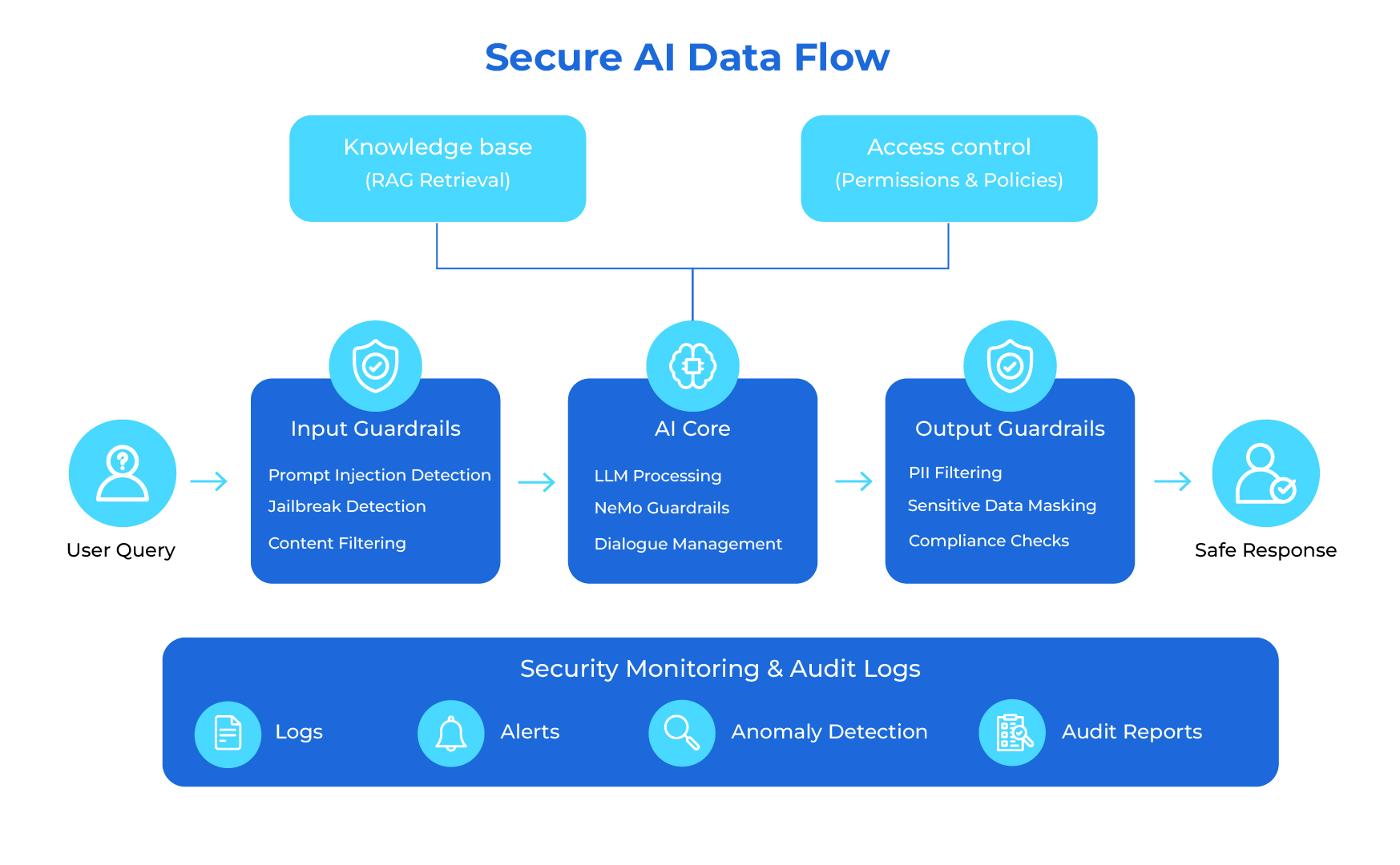
Guardrails act as safety controls between users and AI models, helping manage inputs, guide conversations, and validate responses. NVIDIA NeMo Guardrails is an open-source framework that enables developers to define these controls through configurable rules and policies.
NeMo Guardrails supports three key types of rails:
- Input Rails: Apply topic restrictions, jailbreak detection, and content moderation before user queries reach the model
- Dialog Rails: Guide conversation flows, verify factual responses, and help keep answers grounded in approved sources
- Output Rails: Validate generated responses, filter sensitive information, and apply PII masking before delivery
Workflow: User Input → Input Rails → Dialog Rails → Output Rails → Response
AI Security and Regulatory Compliance
AI security guardrails help reduce data exposure and support regulatory compliance. However, regulatory obligations extend beyond guardrails and require appropriate governance, access controls, and ongoing risk management.
|
Regulation |
Key Requirements |
Potential Penalties |
|
EU AI Act |
Risk management, transparency, human oversight |
Up to €35 million or 7% of global annual turnover for certain violations |
|
GDPR |
Data minimization, purpose limitation, data subject rights |
Up to €20 million or 4% of global annual turnover |
|
SOX |
Internal controls over financial reporting |
Criminal penalties, including imprisonment for certain offenses |
|
HIPAA |
Safeguards for protected health information |
Civil penalties based on violation severity and applicable limits |
Data breaches can result in substantial financial losses, reputational damage, and long-term erosion of customer trust. Proactive AI security controls can help reduce exposure, support compliance efforts, and minimize the potential impact of security incidents.
Key Takeaway: AI systems handling sensitive data require robust guardrails to reduce security risks and support regulatory compliance.
Conclusion
Effective AI security requires validating inputs, controlling processing, and inspecting outputs. Integrating guardrails into RAG pipelines and LLM applications helps mitigate prompt injection, prevent data exposure, and support compliance with regulations such as GDPR, HIPAA, and the EU AI Act. As generative AI adoption grows, organizations must prioritize security through guardrails, access controls, and continuous monitoring to protect sensitive data, strengthen compliance, and maintain stakeholder trust.