
Enterprise adoption of GenAI and Agentic AI is rapidly evolving from isolated pilots to system-wide integrations. But unlocking transformative value at scale demands more than technical deployment, it requires a proactive foundation of trust, accountability and embedded governance. To transition from exploration to enterprise-grade execution, organizations must treat governance not as an afterthought, but as the backbone of secure and compliant AI enablement.
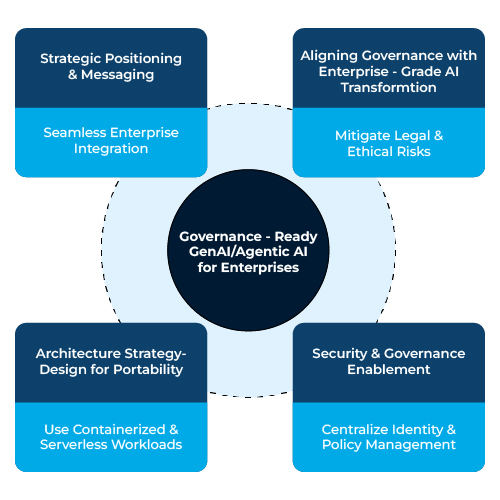
Strategic Positioning/Messaging
Define a differentiated value proposition by positioning governance as the connective layer between advanced AI and compliance-conscious enterprise systems. It aligns innovation with regulatory and operational assurance while enabling responsible scale. Governance ensures AI delivers value with trust and accountability at its foundation.
Seamless integration requires GenAI agents and data pipelines to operate within core workflows with embedded policy enforcement and full audit traceability. Architectures must be modular, portable and centrally governed, aligned from the start with GDPR, HIPAA and ISO/IEC 42001. This ensures consistent oversight across cloud and on-prem environments without limiting agility.
Aligning Governance with Enterprise-Grade AI Transformation
For enterprises moving from pilots to production, governance must evolve from a control layer into an enabler of responsible innovation:
- Mitigate Legal & Ethical Risk – Embed auditing, identity verification and explainability mechanisms early to reduce compliance and ethical risks.
- Operational Resilience with Governance Oversight – Implement real-time observability and rollback capabilities that protect continuity and support incident recovery.
- Accelerate Responsible Innovation – Position governance as a catalyst, not a constraint, for trust-driven experimentation and scalable adoption.
Architecture Strategy for Portability and Scalability
Containerized and serverless workloads boost compliance, resilience and flexibility, while portable GenAI reduces lock-in and ensures governance across hybrid and multi-cloud.
- Containerize Models/Agents – Ensure consistent deployment across AWS, Azure, GCP and on-premises environments.
- Serverless Adoption – Use AWS Lambda, Azure Functions and Google Cloud Run while enforcing IAM policies and minimizing platform dependence.
- Infrastructure as Code (IaC) – Implement Terraform, Pulumi and Ansible with policy-as-code integrations such as OPA and Kyverno for automated governance.
Interoperable APIs and abstraction layers enable flexibility and embedded governance:
- Standardized APIs – Interface agents and models using REST or gRPC to enable swappable components and integrations
- Policy Middleware – Abstract enforcement, auditing and observability logic into middleware that operates independently of cloud-specific services
Security and Governance Enablement
Centralized Identity and Policy Management
Security defines access rights to enforce trust and prevent unauthorized AI use across environments.
- Federated Identity – Integrate with enterprise identity systems using OIDC, SAML and tools like Okta, Auth0 or Keycloak.
- RBAC & ABAC Controls – Enforce least-privilege access and contextual permissions based on user roles, data sensitivity and task type.
- Policy-as-Code – Use OPA, Azure Policy, Kyverno and Anthos Policy to encode governance logic declaratively and enforce consistently across containers, pipelines and user sessions.
Model/Agent Governance
Autonomous agents and GenAI models must be governed with full traceability and accountability:
- Prompt Auditing – Log, inspect and trace prompt history to investigate unintended behavior.
- Fine-Tuning Lineage – Record versions, datasets and objectives during every tuning process.
- Explainability: Offer output justification and decision tracebacks through interpreters or reasoning summaries.
- Artifact Storage – Persist prompts, configurations and evaluations in portable formats using PostgreSQL, MinIO or similar artifact registries.
Monitoring and Observability
Unified Logging/Tracing
Observability across all GenAI stages enables unified, transparent oversight and effective governance.
- OpenTelemetry – Instrument every model, API and agent interaction with distributed tracing and metrics.
- Prometheus & Grafana – Visualize performance, error rates and usage patterns in real time.
- Security Information and Event Management (SIEM) Integration – Route behavioral, access and audit logs into enterprise SIEM systems like Splunk, Datadog, Dynatrace, LogRhythm, ELK Stack, etc.
Agent Behavior Simulation
Before deploying autonomous agents, simulate how they behave under real-world conditions. Simulations reduce downstream incidents and help codify “acceptable behavior” before actual deployment.
- Sandbox Environments – Test agent actions using synthetic data or mock services to detect policy violations.
- Scenario Testing – Validate behavior under adversarial conditions, misleading inputs, boundary pushes or ethical dilemmas.
- Governance Compliance Scans – Score agents against regulatory, safety and ethical checklists before release.
GenAI Safety/Evaluation
Embed safety tooling throughout the stack to make it an active GenAI component.
- Prompt Injection Detection – Use libraries that recognize and neutralize attack attempts.
- Toxicity & Bias Filters – Scan outputs for violations of company policy or harmful content.
- Red-Teaming Evaluations – Stress-test models for unintended behavior or policy circumvention.
Governance Partnerships/Compliance
Federated Governance Models
Enterprise AI crosses clouds, teams, and regulations; federated governance provides unified oversight.
- Metadata Registries – Use systems like IDMC, DataHub, Azure Purview, AWS Glue Data Catalog, Google Dataplex Universal Catalog or Amundsen to track data & model dependencies.
- Cross-Cloud Policy Engines – Sync policies across Azure, AWS and GCP via distributed Open Policy Agent (OPA) clusters.
- Compliance Dashboards – Create Governance, Risk and Compliance (GRC) overlays that consolidate signals across observability, policy & execution platforms.
Compliance-First Certifications
Reinforce the organization’s commitment to trustworthy AI with recognized compliance standards.
- ISO/IEC 42001 – Emerging global standard for AI Management Systems.
- NIST AI RMF – Demonstrates alignment with US federal risk frameworks.
- SOC 2, FedRAMP, GDPR – Essential credentials for regulated or international clients.
Strategize Business Development
In regulated industries, governance resonates most where compliance is non-negotiable; build pre-packaged solutions with sector-specific controls & compliance templates.
- Healthcare: Privacy-sensitive patient chatbots, diagnostic models or prior-authorization automation
- Finance: Loan underwriting, fraud detection or customer service with full auditability
- Energy and Utilities: AI agents managing safety-critical infrastructure or outage responses
- Government: GenAI-driven constituent engagement, procurement automation & document classification
Governance as an Innovation Accelerator: While unchecked AI velocity raises concerns, governed velocity fosters trust, ensures resilience and drives sustainable value.
- Pilot with Confidence: Deploy focused programs with audit readiness, safety filters and observability to reduce rework and boost ROI
- Accelerator-Grade Bundles: Bundle risk modeling, behavior simulation and compliance into go-to-market kits to speed adoption and build trust
Conclusion
GenAI and autonomous agents have moved beyond experimentation and are delivering measurable impact across enterprise ecosystems. Yet, without embedded governance, portability and security, these systems risk becoming opaque and unmanageable. To lead with confidence and scale responsibly, organizations must architect GenAI solutions with cloud neutrality, a cross-functional governance framework and real-time observability. This triad transforms GenAI from potential liability into a trusted innovation platform.
Governance is not a barrier, it is the infrastructure that unlocks secure, scalable autonomy embedded in every GenAI workflow, agent and decision.