
Effective Cloud Cost Reduction Techniques for Modern Cloud Environments
Cloud computing offers scalable resources and reduces upfront infrastructure costs, fundamentally transforming how businesses operate. However, cloud expenses can increase rapidly without proper management. Over-provisioned resources, limited visibility, and inefficient usage often lead to unnecessary spending. Without a structured approach, organizations risk overspending while failing to fully optimize their cloud investments.
By implementing effective cost optimization strategies, organizations can reduce expenses while maintaining performance and scalability. This article outlines practical techniques to achieve cost efficiency without compromising system performance.
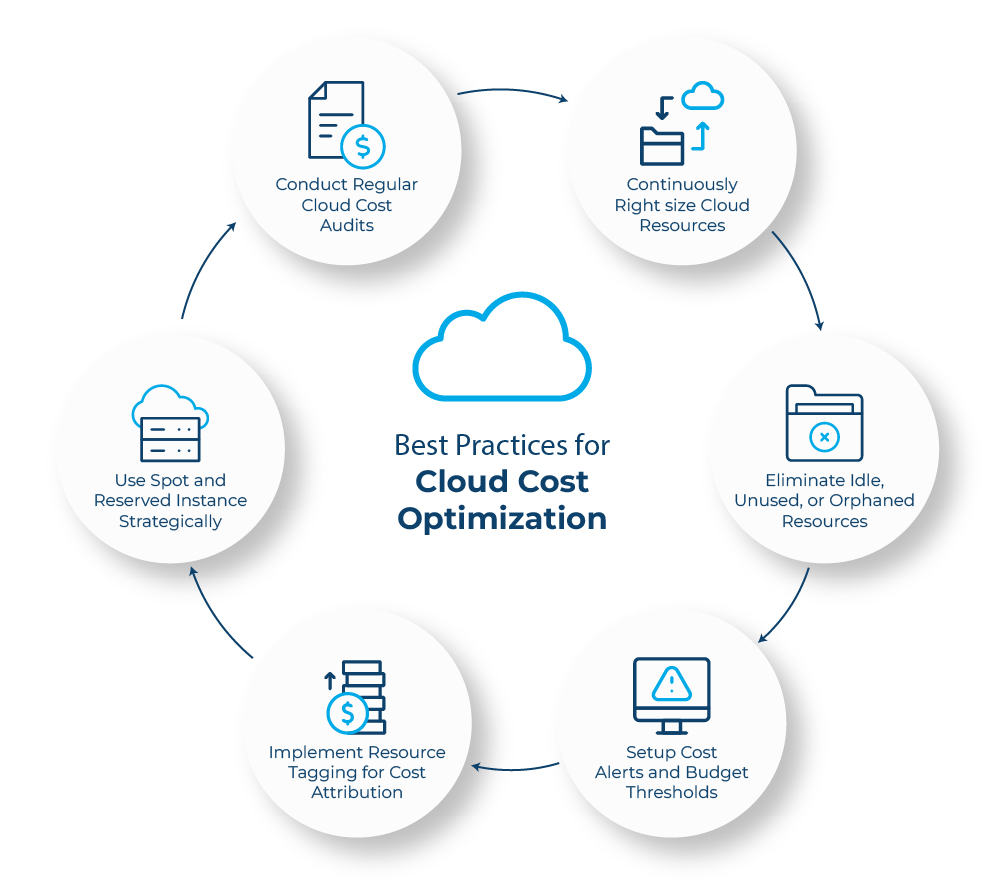
Key Cloud Cost Reduction Techniques
1. Proper Resource Sizing
Over-provisioning resources is one of the most common causes of excessive cloud expenses. Right-sizing involves analyzing workloads and selecting appropriate instance sizes and types. To identify unused resources, organizations can use tools from cloud platforms, such as Google Cloud Recommender, Azure Advisor, and AWS Trusted Advisor. These tools help implement effective cloud cost optimization strategies.
For official best practices on managing and optimizing cloud costs, refer to the documentation from Amazon Web Services and Microsoft Azure.
2. Utilize Savings Plans and Reserved Instances
Cloud providers offer discounted pricing for long-term commitments. Additionally, Reserved Instances and Savings Plans enable businesses to purchase capacity at a lower cost compared to on-demand pricing. To maximize benefits, organizations should analyze historical usage patterns and align commitments with predictable workloads to avoid underutilization or overcommitment.
3. Auto-Scaling for Cloud Cost Reduction
Auto-scaling dynamically adjusts compute resources based on real-time demand and traffic patterns. This ensures that organizations use only the resources they need at any given time. By implementing well-defined auto-scaling policies, businesses can avoid paying for idle capacity while maintaining consistent application performance during demand spikes.
4. Continuously Monitor and Evaluate Usage
Monitoring tools provide detailed insights into resource utilization and system performance. Services such as AWS CloudWatch, Azure Monitor, and Google Cloud Operations Suite help identify unused or underutilized resources. Regular tracking enables organizations to remove idle virtual machines, unused storage volumes, and outdated snapshots, ensuring continuous cost optimization.
5. Apply Cost Allocation Tags
Cost allocation tags help organizations track spending across teams, projects, and departments. Proper tagging enables better visibility into how cloud resources are being consumed. With clear categorization, organizations can allocate budgets more accurately, identify high-cost workloads, and improve accountability across different business units.
6. Use Spot Instances and Preemptible Virtual Machines
Spot Instances and Preemptible Virtual Machines offer significantly lower pricing compared to standard on-demand resources. These options are suitable for workloads that are flexible and can tolerate interruptions. They are commonly used for batch processing, testing environments, and non-critical workloads where cost savings are prioritized over guaranteed availability.
7. Cloud Cost Reduction Through Storage Optimization
Cloud storage costs can grow rapidly if not managed efficiently. Selecting the appropriate storage tier based on access frequency is essential for cost control. Organizations should use hot storage for frequently accessed data and cold or archival storage for infrequently accessed data, while regularly deleting outdated backups and unnecessary snapshots.
8. Adopt Serverless Architectures
Serverless computing allows organizations to run applications without managing underlying infrastructure. Services such as AWS Lambda, Azure Functions, and Google Cloud Functions charge only for actual compute usage. This approach eliminates idle resource costs and is particularly effective for event-driven workloads and applications with variable demand patterns.
9. Utilize Cost Management Tools
Cloud cost management tools provide centralized visibility into usage and spending. Solutions such as CloudHealth, Spot.io, and native cloud dashboards help organizations track, analyze, and optimize costs. These tools offer recommendations, forecasting capabilities, and detailed reports to support informed financial and architectural decisions.
10. Build a Cost-Aware Culture
Building a cost-conscious culture is essential for long-term cloud cost optimization. Teams involved in development and operations should consider cost implications during design and deployment. Encouraging accountability and awareness ensures that cloud resources are used efficiently and that cost optimization becomes an ongoing organizational practice.
Conclusion
Cloud cost reduction is no longer optional but a strategic imperative for the future, demanding continuous monitoring, disciplined optimization, and data-driven decision-making. By combining right-sizing, intelligent pricing models, auto-scaling, and real-time visibility, organizations can take control of cloud spending without compromising performance.
As cloud adoption accelerates, building a cost-aware culture becomes essential, enabling teams to align every technical decision with financial impact and ensure that every cloud investment consistently delivers measurable, long-term business value.