Prompt → Generate Code → Accept Changes → Ship
The pattern is becoming increasingly familiar: massive AI‑generated pull requests, 128k‑line diffs turned into engineering memes, and codebases bloated with logic that no one fully understands. The irony is painful. AI was supposed to reduce complexity, not multiply it.
Yet the real problem isn’t the AI itself. It’s the cognitive load.
We are still coding like it’s 2015, except now we have a superhuman assistant that can generate code faster than we can comprehend it. The bottleneck isn’t typing speed. It is understanding, context, and architectural clarity.
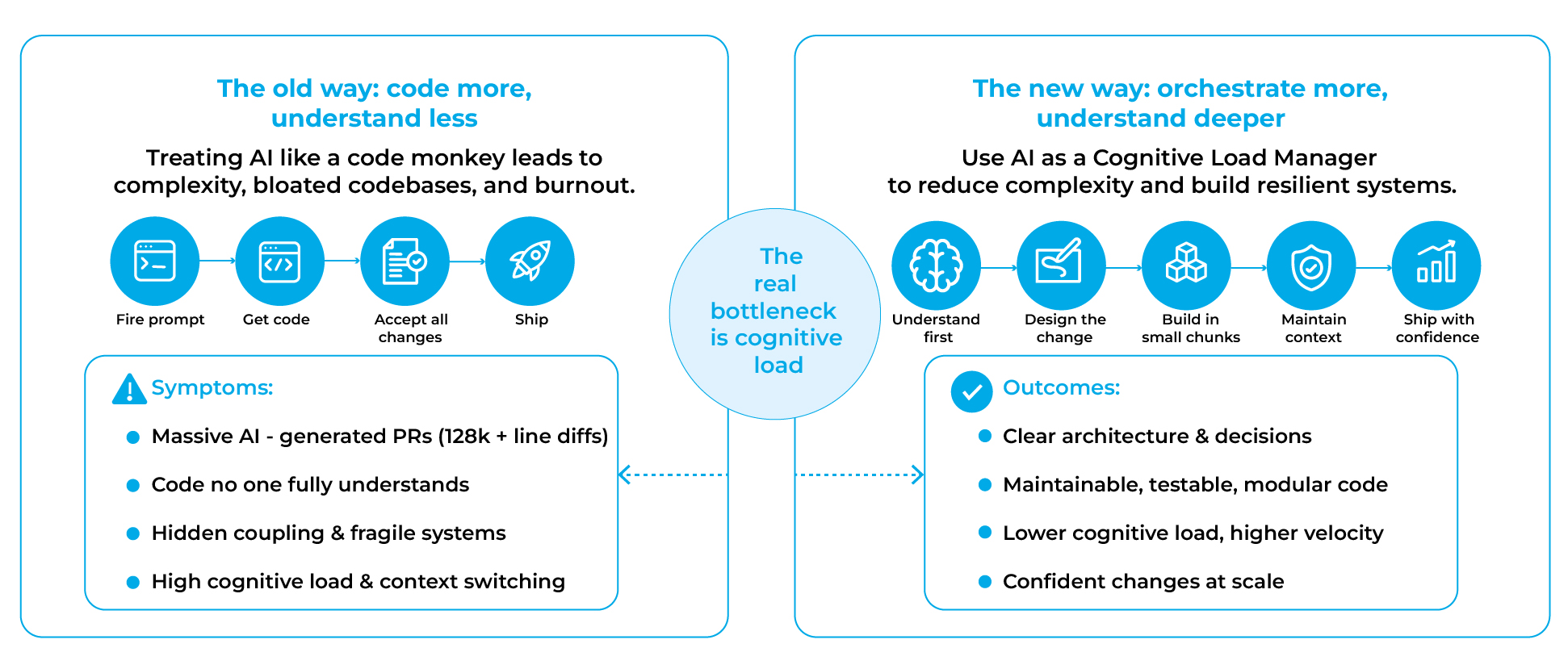
The best engineers have already figured this out. Their advantage is not simply coding faster, but thinking differently. Instead of treating AI as a code generator, they are using it for Cognitive Load Management.
The New Workflow: Orchestrating, Not Coding
The elite engineers, the ones shipping significantly faster without compromising system stability, follow a very different workflow. It looks more like orchestration than programming.
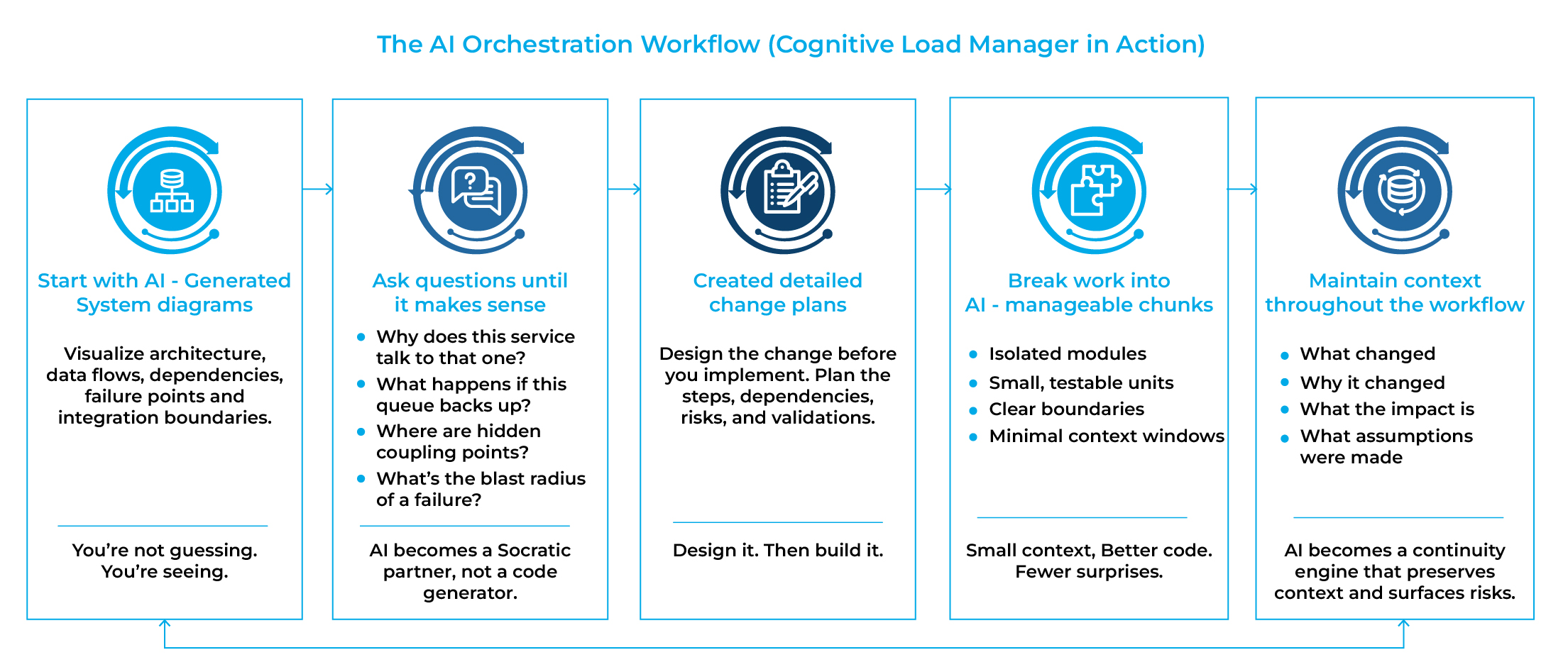
1. Start with AI‑Generated System Diagrams
Before a single line of code is written, they ask AI to visualize the architecture, not just boxes and arrows, but also data flows, dependencies, failure points, and integration boundaries.
This instantly reduces cognitive load management by giving engineers visibility into the system before implementation begins.
2. Ask Questions Until the Architecture Makes Sense
They interrogate the diagram like a senior architect reviewing a million‑dollar system.
- Why does this service talk to that one?
- What happens if this queue backs up?
- Where are the hidden coupling points?
- What’s the blast radius of a failure?
AI becomes a Socratic thought partner, not just a code generator.
3. Create Detailed Change Plans
Only once the architecture is understood do they ask AI to help create a step‑by‑step change plan. This is where many developers move too quickly. They jump straight into code generation and drown in complexity.
The pros don’t. They design the change before they implement it.
4. Break Work Into AI‑Manageable Chunks
Instead of asking AI to “build the feature,” they break the work into:
- Isolated modules
- Small, testable units
- Clear boundaries
- Minimal context windows
This is how you avoid 128k‑line pull request bottlenecks.
5. Maintain Context Throughout the Workflow
High-performing engineers treat context like gold. They keep a running architectural narrative:
- What changed?
- Why did it change?
- What is the impact?
- What assumptions were made?
AI becomes a continuity engine, tracking decisions, surfacing risks, and preserving architectural context that teams often lose over time.
This isn’t coding. This is systems orchestration.
The Shift: From IDEs to Cognitive Load Management
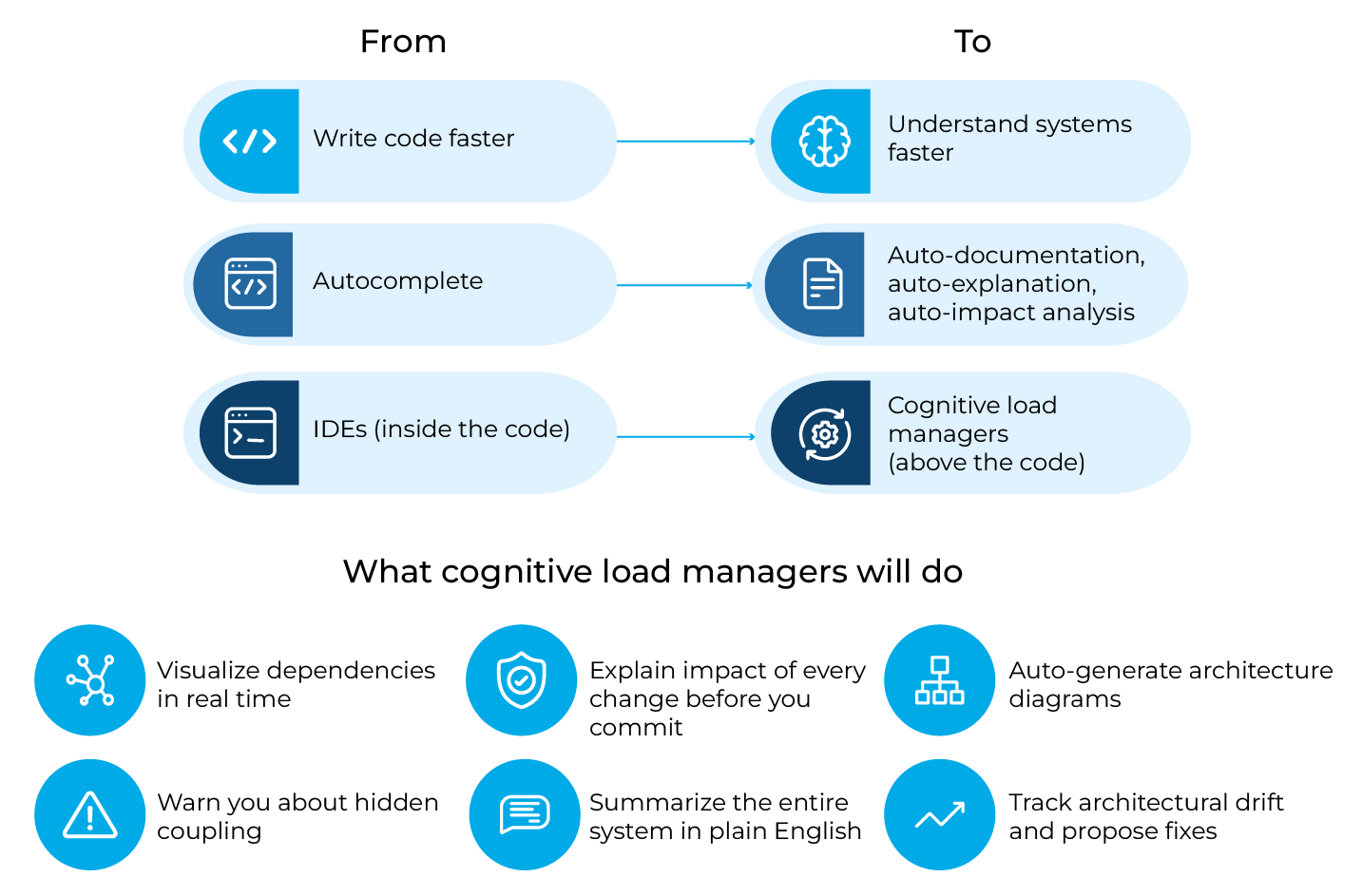
Think about where tools are heading. We are moving from:
- “Write code faster” to “Understand systems faster”
- Auto-complete to auto‑documentation, auto‑explanation, and auto‑impact analysis
- IDEs to Cognitive Load Management that sit above the code, not inside it
Imagine tools that:
- Visualize dependencies in real time
- Explain the impact of every change before you commit
- Auto‑generate architecture diagrams as you build
- Warn you when you are introducing hidden coupling
- Summarize the entire system in plain English
- Track architectural drift and propose fixes
This is the real future of engineering. AI will not replace engineers. It will reduce the cognitive burden that limits them.
The Future Engineer: A Systems Architect Who Happens to Code
The next generation of engineers won’t be measured by how fast they type or how many lines they write. They will be measured by:
- How well they orchestrate AI agents?
- How clearly they understand system behavior?
- How effectively they manage complexity?
- How quickly they move from idea to architecture?
- How confidently they maintain system integrity at scale?
The best engineers won’t be “coding.” They will be conducting. AI agents will handle repetitive, mechanical, and low-context tasks. Humans will focus on vision, architecture, constraints, trade-offs, and reasoning.
The real opportunity isn’t another code generator. It’s the platform that transforms every developer into a systems-level thinker.
A Tool That Elevates Every Engineer
If this future becomes reality, it exposes a missing layer in today’s engineering stack: a unifying intelligence layer that can:
- Reduce cognitive load by absorbing the mental overhead engineers carry across tools, systems, and decisions
- Preserve architectural clarity by continuously mapping, validating, and explaining how everything fits together
- Manage context end‑to‑end across design, development, deployment, and operations
- Orchestrate multiple AI agents into a coordinated, governed workflow instead of isolated point solutions
- Turn complexity into something you can see, question, and control through real‑time visibility, reasoning, and explainability
Not AI that writes code. AI that helps engineers understand what code should exist in the first place.
The Bottom Line
The future of engineering belongs to those who stop viewing AI as a junior developer and start using it as a cognitive exoskeleton. The real advantage will come from orchestrating with intention, designing proactively, understanding systems with clarity, and managing complexity without being overwhelmed by cognitive load.
We are not automating developers out of existence. We are elevating developers into roles that were previously inaccessible.