How Do Modern Query Languages Power Distributed Data Platforms?
In modern data-driven enterprises, the question is no longer about whether to use data. It is about how effectively we can access, model, and extract value from it. At the center of this capability lies a critical yet often underestimated component: QUERY LANGUAGES power distributed data platforms
SQL has dominated for decades, but today’s architectures extend far beyond traditional relational databases (RDBMSs). Distributed data lakes, graph databases, real‑time event streams, and API‑driven ecosystems have introduced a new generation of query paradigms built for diverse workloads and data models.
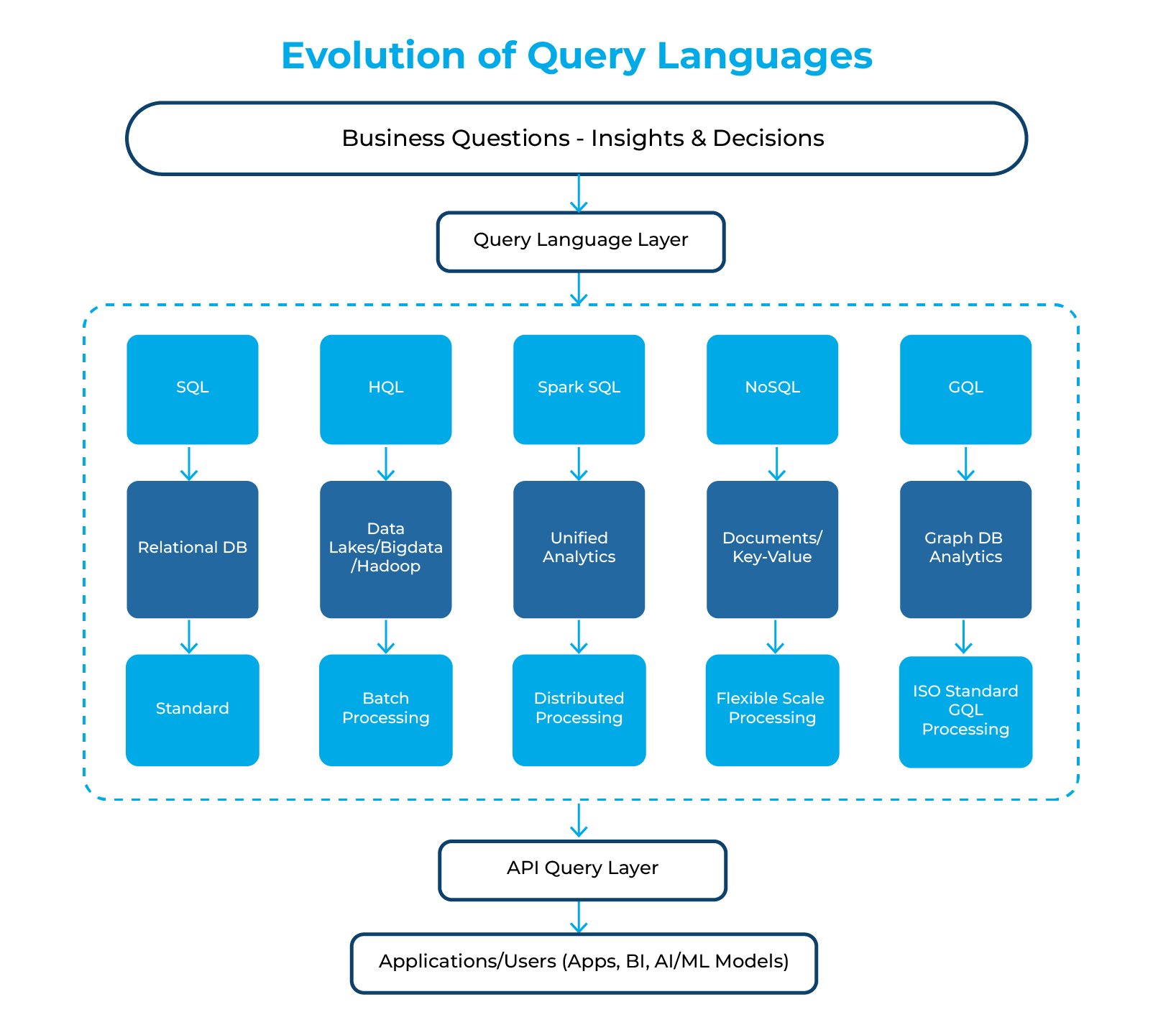
Let’s have an executive-level perspective on modern query languages such as SQL, NoSQL, GQL, Spark SQL, and others, focusing not just on what they are, but also on when and why they matter in enterprise data strategy.
Foundation: SQL as the Universal Language of Data Platforms
SQL (Structured Query Language) remains the backbone of enterprise data operations. Its strength lies in its simplicity, standardization, and deep integration across nearly every analytics and reporting platform. From transactional systems to enterprise data warehouses, SQL provides a consistent way to manage structured data. Its declarative nature allows users to focus on what they want rather than how to retrieve it, making it both powerful and accessible.
However, SQL was designed in an era when data was largely structured and relational. As organizations began dealing with semi-structured, unstructured, and highly connected datasets, SQL alone became insufficient to address emerging complexities.
Rise of Relationships: GQL
Modern enterprises increasingly deal with connected data, such as fraud detection, recommendation engines, supply chain networks, or social graphs. In such cases, relationships are just as important as the data itself. Graph Query Languages (GQL), such as Cypher and Gremlin, are purpose-built for these scenarios. Instead of forcing relationships into rigid table joins, they treat connections as first-class citizens.
This enables faster, more intuitive traversal of multi-hop relationships. For example, identifying indirect fraud connections or mapping system dependencies becomes far more efficient.
From an executive standpoint, Graph Query Languages enable:
- Faster insights into complex, relationship-driven use cases
- More natural modeling of real-world systems
- Reduced computational overhead compared to deep join operations
Scaling the Data Lake: HiveQL & Distributed Querying
As organizations embraced big data, traditional databases struggled to handle the sheer volume and variety of information. This led to the rise of distributed frameworks and data lakes. HiveQL emerged as a bridge between traditional SQL users and the Hadoop ecosystem. It allows users to query massive datasets stored across distributed systems using familiar SQL-like syntax.
While HiveQL excels in batch processing and large-scale analytics, it is not designed for real-time workloads. Queries can take minutes or even hours, depending on data size and complexity. Yet its value lies in:
- Enabling SQL users to work with petabyte-scale datasets
- Supporting ETL pipelines in data lake architectures
- Serving as a foundational layer for many modern data platforms
Flexibility at Scale: NoSQL Query Languages
The rise of web-scale applications introduced new requirements including high throughput, low latency, and flexible schemas. This is where NoSQL query languages come into play. Unlike traditional SQL systems, NoSQL databases support document, key-value, and wide-column data models. Their query languages, such as MongoDB’s JSON-based queries and Cassandra Query Language (CQL), are optimized for performance and scalability rather than complex joins.
From a strategic perspective, NoSQL query languages enable:
- Rapid development with evolving data models
- Horizontal scalability across distributed systems
- Real-time responsiveness for user-facing applications
However, this flexibility often comes with trade-offs, including limited support for complex analytical queries and reduced consistency in some architectures.
Power Engine: Spark SQL & Unified Analytics
As data engineering matured, organizations sought platforms that could handle batch processing, real-time streaming, and machine learning in a unified way. Apache Spark, particularly Spark SQL, addresses this need. This extends traditional SQL capabilities into distributed, in-memory computing environments. It allows organizations to run high-performance queries across massive datasets while integrating seamlessly with data science workflows.
Its key advantages include:
- High-speed processing through in-memory computation
- Integration with structured, semi-structured, and unstructured data
- Support for advanced analytics and machine learning pipelines
For enterprises pursuing AI-driven insights, Spark SQL is often a cornerstone technology.
API Revolution: GraphQL
While most query languages operate at the DB layer, GraphQL represents a shift toward API-driven data access. Designed for modern front-end and mobile applications, GraphQL allows clients to request exactly the data they need, no more, no less. This eliminates common over-fetching and under-fetching issues in REST APIs.
From an architectural standpoint, GraphQL provides:
- Improved performance for client applications
- Greater flexibility in data consumption
- A unified interface across multiple backend services
Although not a DB query language, GraphQL plays a crucial role in how data is exposed and consumed in modern digital ecosystems.
Multidimensional Thinking: MDX & OLAP Querying
Before the rise of modern BI tools, multidimensional databases were the standard for analytical reporting. MDX (Multidimensional Expressions) was designed specifically for querying OLAP cubes. Although less common today, MDX remains relevant in legacy systems and specialized financial reporting environments. It excels in scenarios requiring complex aggregations across multiple dimensions.
Strategic Comparison: Choosing the Right Query Language
From an executive perspective, the choice of QL should align with business priorities, data architecture, and scalability requirements.
- SQL remains the default for structured data and enterprise reporting
- GraphQL excels in relationship-driven insights and transforms how data is delivered to applications
- HiveQL supports large-scale batch processing in data lakes
- NoSQL query languages power high-performance, flexible applications
- Spark SQL enables unified analytics and AI-driven workloads
Rather than viewing these as competing technologies, forward-thinking organizations adopt a polyglot data strategy, using multiple query languages based on the specific use case.
Executive Takeaway
The modern data landscape is no longer monolithic. It’s a dynamic ecosystem where different data models coexist, each requiring specialized tools for optimal performance. Query languages are not just technical constructs; they are strategic enablers. The right choice can accelerate insights, improve scalability, and unlock new business capabilities.
For leaders driving data modernization, the key is not to replace SQL, but to augment it. Embracing a portfolio of query languages that align with evolving data needs. In the end, success lies in asking the right question, not just of your data, but of the language you use to query it.