
Introduction
Cyber threats continue to evolve in complexity, making proactive security assessments a necessity. While traditional security controls such as firewalls, antivirus software, and endpoint detection solutions provide important layers of defense, organizations must validate whether these controls can withstand real-world attacks. Penetration testing, or pen testing, simulates real-world attacks in a controlled environment to identify vulnerabilities before malicious actors can exploit them, providing actionable insights into an organization’s security posture.
What Is Penetration Testing?
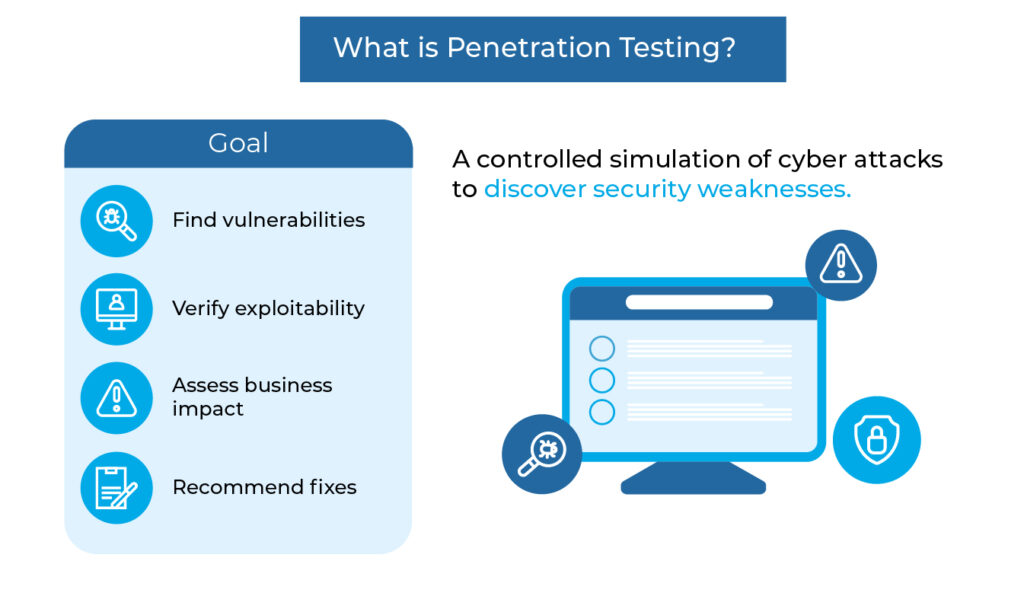
Penetration testing is an authorized security assessment performed by ethical hackers who simulate cyberattacks against an organization’s infrastructure, applications, cloud environments, APIs, wireless networks, or employees.
The primary objectives are to:
- Identify exploitable vulnerabilities
- Validate existing security controls
- Assess the business impact of security weaknesses
- Provide remediation recommendations
- Improve overall cyber resilience
Unlike vulnerability assessments, which identify known weaknesses, penetration testing attempts to exploit vulnerabilities in a controlled environment to determine their actual risk.
Why Organizations Need Penetration Testing
Modern attack surfaces extend far beyond traditional data centers. Organizations now operate across cloud platforms, remote work environments, mobile devices, third-party integrations, and APIs.
Regular penetration testing helps organizations:
- Discover hidden attack paths
- Identify configuration weaknesses
- Validate patch management effectiveness
- Detect privilege escalation opportunities
- Evaluate authentication and access controls
- Meet regulatory compliance requirements
- Reduce the likelihood of successful cyberattacks
Penetration testing also provides executive leadership with measurable insights into cybersecurity risks and investment priorities.
The Penetration Testing Process
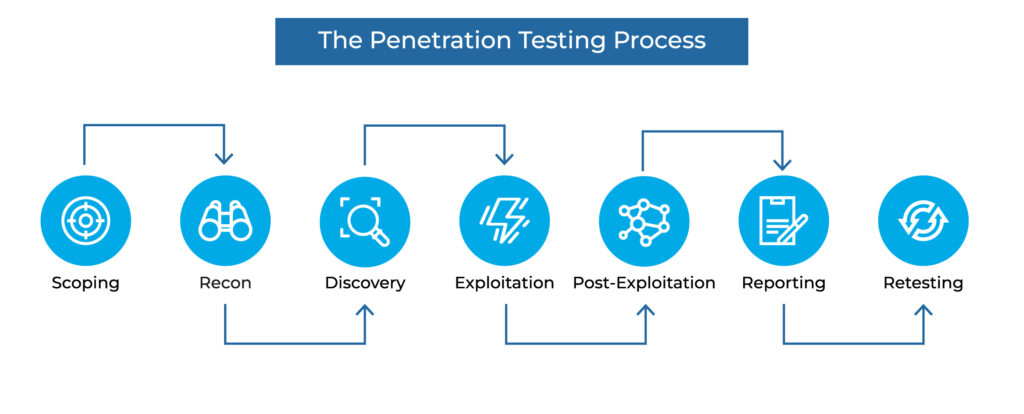
Phase 1: Planning and Scoping
This stage defines:
- Objectives
- Rules of engagement
- Systems in scope
- Testing timelines
- Communication procedures
- Success criteria
Phase 2: Reconnaissance
Information gathering begins by collecting publicly available and technical intelligence.
Activities include:
- DNS enumeration
- WHOIS lookups
- Subdomain discovery
- Technology fingerprinting
- Employee intelligence
- Public asset identification
Reconnaissance often reveals unexpected attack opportunities before active testing begins.
Phase 3: Vulnerability Identification
Using automated tools alongside manual analysis, testers identify potential weaknesses.
Examples include:
- Missing patches
- Misconfigurations
- Weak encryption
- Default credentials
- Open ports
- Insecure services
Manual verification helps reduce false positives.
Phase 4: Exploitation
Ethical hackers attempt to exploit discovered vulnerabilities to determine their real-world impact.
This may involve:
- Remote code execution
- Privilege escalation
- Password attacks
- Authentication bypass
- Data access validation
- Lateral movement
Exploitation is carefully controlled to avoid disrupting production systems.
Phase 5: Post-Exploitation
Once access is obtained, testers assess:
- Sensitive data exposure
- Privilege levels
- Business impact
- Persistence opportunities
- Internal network movement
The goal is to understand how far an attacker could realistically progress.
Phase 6: Reporting
The final report is often the most valuable deliverable.
A quality report includes:
- Executive summary
- Technical findings
- Risk ratings
- Evidence
- Attack paths
- Business impact
- Remediation recommendations
- Prioritized action plan
Clear reporting enables security teams to address vulnerabilities effectively.
Common Penetration Testing Methodologies
Organizations commonly follow recognized frameworks such as:
- PTES (Penetration Testing Execution Standard)
- NIST SP 800-115
- OWASP Testing Guide
- OSSTMM
These methodologies promote consistency, repeatability, and comprehensive coverage.
Industry Insights
Automation Is Not Enough
Automated vulnerability scanners are valuable for identifying known issues but cannot fully replicate an attacker’s thought process. Experienced penetration testers combine automation with manual analysis to uncover chained vulnerabilities, business logic flaws, and complex attack paths.
Cloud Security Requires Specialized Skills
As organizations migrate workloads to the cloud, testing increasingly focuses on identity management, misconfigurations, exposed storage, container environments, and cloud-native services. Cloud penetration testing has become a core requirement for many enterprise security programs.
APIs Are a Growing Attack Surface
Organizations continue to expose more APIs to support mobile applications, SaaS integrations, and microservices. As a result, API security testing has become an essential component of modern penetration testing engagements.
Continuous Security Validation
Rather than conducting annual penetration tests solely for compliance, many organizations are adopting continuous security validation. Frequent testing following major infrastructure changes, application releases, or cloud deployments helps identify new risks before they can be exploited.
Business Context Matters
Not every vulnerability carries the same level of risk. Effective penetration testing prioritizes findings based on exploitability, business impact, asset criticality, and the likelihood of real-world exploitation. This enables organizations to focus remediation efforts where they matter most.
Conclusion
Penetration testing is more than a compliance exercise—it is a strategic security practice that helps organizations understand how attackers might compromise their environments and where defenses can be strengthened. By following a structured methodology, combining technical expertise with business context, and incorporating testing into an ongoing security program, IT teams can identify weaknesses early, reduce organizational risk, and build greater resilience against evolving cyber threats.