
Introduction
Manually provisioning cloud resources is often complex, time-consuming, and prone to errors. Infrastructure as Code (IaC) addresses these challenges by enabling developers and DevOps engineers to define, provision, and manage cloud environments through code instead of manual configuration. Pulumi builds on this approach by allowing teams to use familiar programming languages such as Python, TypeScript, JavaScript, C#, and Go to automate deployments, eliminating the need to learn a separate domain-specific configuration language.
What is Pulumi?
Pulumi is an Infrastructure as Code (IaC) platform that enables teams to create, deploy, and manage cloud infrastructure using familiar programming languages. It supports multiple cloud providers, including:
In addition to cloud providers, Pulumi supports container orchestration platforms such as Kubernetes, making it a powerful choice for innovative cloud-native applications. By using familiar programming languages, teams can use concepts such as loops, functions, classes, and reusable modules to build and manage infrastructure more efficiently and consistently.
Why Pulumi?
Pulumi reduces the learning curve by allowing developers to manage infrastructure using familiar programming languages. It integrates with package ecosystems such as npm, PyPI, and NuGet while supporting standard testing frameworks, enabling reusable, maintainable, and scalable code for modern cloud environments.
Key Features
Multi-Cloud Support
Pulumi supports major cloud platforms such as AWS, Microsoft Azure, and Google Cloud Platform, allowing organizations to manage infrastructure across multiple environments using a single tool.
Infrastructure Reusability
Pulumi enables developers to create reusable components that can be shared across projects, improving consistency, reducing duplication, and accelerating the deployment of new environments.
Programming Language Support
Developers can write infrastructure code using familiar programming languages such as Python, TypeScript, JavaScript, Go, and C#, eliminating the need to learn specialized configuration languages.
Built-in State Management
Pulumi automatically tracks state and compares the desired configuration with the current environment before applying changes, ensuring updates remain safe, predictable, and reliable.
Strong DevOps Integration
Pulumi integrates seamlessly with CI/CD tools such as GitHub Actions, Jenkins, and GitLab CI/CD, enabling faster, automated, and consistent delivery of structures and applications.
Workflow
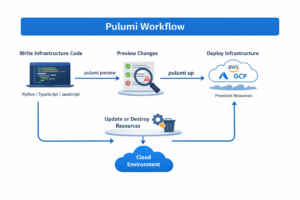
How Pulumi Works
Understanding Pulumi’s workflow helps illustrate how infrastructure is provisioned and managed throughout its lifecycle. The Pulumi workflow is simple and closely resembles advanced software development practices. Instead of provisioning resources manually through cloud consoles, developers define and manage infrastructure using code and the Pulumi CLI.
1. Write Infrastructure Code
Developers define cloud resources using supported programming languages such as Python or TypeScript. Resources may include virtual machines, storage, databases, and networking components managed through code.
2. Preview Changes
Before deployment, developers run the pulumi preview command to review the planned changes. This process identifies resources that will be created, updated, or deleted before execution.
3. Provision Cloud Resources
After validating the preview results, developers use the’ pulumi up’ command to deploy the infrastructure. Pulumi automatically provisions the required cloud resources based on the defined configuration.
4. Update or Destroy Resources
Infrastructure changes are made by updating the code and redeploying it. Pulumi detects differences, applies updates, and safely removes unnecessary resources using the pulumi destroy command.
Why Pulumi Over Terraform?
Pulumi and Terraform are both powerful Infrastructure as Code (IaC) tools, but they differ in their approach. Terraform uses HashiCorp Configuration Language (HCL), a domain-specific language designed for resource provisioning and cloud management. In contrast, Pulumi enables software engineers to define and manage cloud resources using familiar general-purpose programming languages.
Advantages of Pulumi
- Allows developers to leverage existing programming knowledge and skills
- Simplifies the implementation of complex infrastructure logic and workflows
- Supports reusable, modular, and maintainable infrastructure code
- Integrates naturally with advanced application development practices and toolchains
Terraform continues to have a large community, extensive provider support, and a mature ecosystem, making it a preferred choice for many organizations. However, Pulumi is gaining popularity among developer-centric teams that value flexibility, code reusability, and the ability to work with familiar programming languages.
When Should You Use Pulumi?
Pulumi is an excellent choice for teams adopting a developer-centric approach to Infrastructure as Code (IaC). It is particularly well-suited for scenarios such as:
- Implementing complex logic, automation, or dynamic cloud configurations
- Building reusable and modular components that can be shared across projects
- Integrating application and infrastructure code within a unified development workflow
- Streamlining CI/CD pipelines for automated provisioning and delivery
For organizations embracing modern DevOps practices and cloud-native development, Pulumi simplifies cloud management while improving consistency, scalability, and team productivity.
Conclusion
Pulumi bridges the gap between software engineering and cloud management by enabling engineering teams to define and manage cloud resources using familiar programming languages. By integrating application and infrastructure code together, teams can build environments that are easier to automate, scale, and maintain. As organizations continue to adopt DevOps practices and cloud native architectures, Pulumi provides a flexible and modern approach to building reliable, scalable, and maintainable cloud solutions.