
Introduction
Imagine asking a company’s AI assistant a simple question: “Why was Project X delayed?” The information needed to answer that question may exist across the organization: a discussion in Slack, a Jira ticket updated months ago, a decision made during a Teams meeting, or an email from the project manager. However, the issue is not necessarily the AI model itself, but fragmented context that makes it difficult to connect these pieces of information, understand their relationships, and provide an accurate answer. Therefore, organizations need a way to connect information across sources and provide AI with the context required for reliable reasoning.
The Challenge of Fragmented Enterprise Context
How can organizations give AI access to all the information it needs to generate an accurate answer? Can it explain why a decision was made or understand the history behind a project issue? For many organizations, though, the answer is no.
Organizations often believe that deploying the latest AI models with billions of parameters and larger context windows will automatically make their AI systems smarter and more reliable. Yet, in real-world business environments, the bigger challenge is often fragmented context.
- Slack messages
- Jira tickets
- Emails
- Documents
- CRMs and databases
- Meeting notes and recordings
Even advanced AI models can struggle when this information remains disconnected. The issue is not only how much information AI can process, but whether it has the right context. Context Architecture connects and organizes information across sources, giving AI a unified view of organizational knowledge rather than isolated pieces.
Why Context Architecture Is Needed
AI models can process large amounts of data, but they still need the right context to generate meaningful and accurate responses. Think of enterprise knowledge as a puzzle. A powerful AI model can solve it quickly, but if pieces are scattered across different rooms, neither speed nor a larger context window is enough. Instead, Context Architecture brigs this information together while preserving the relationships among them. At the same time, it maintains evolving business context, helping AI understand both the current state and the history behind it.
Building a Context Architecture
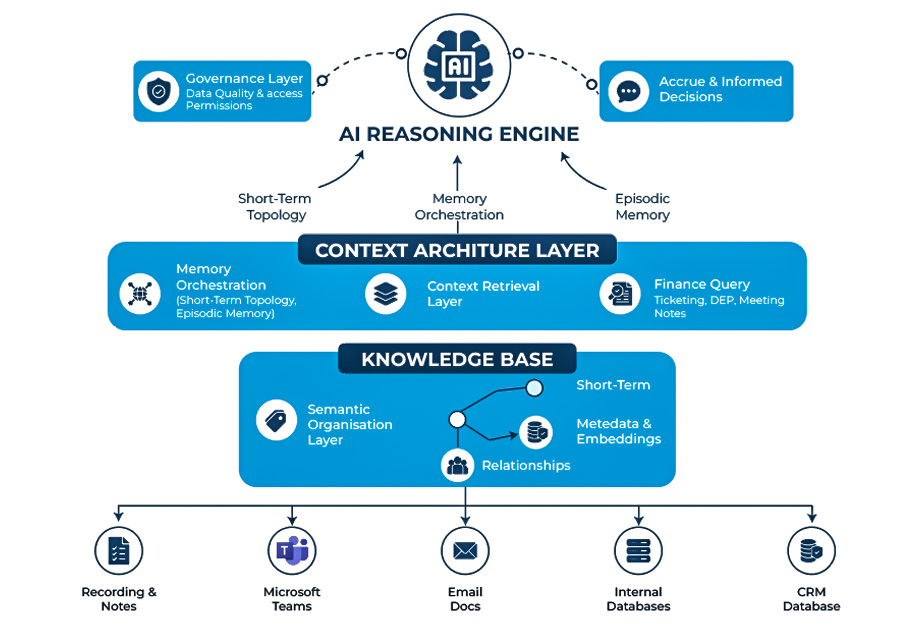
Identifying knowledge sources:
Identifying where important business knowledge resides is a key step in understanding what data can be connected to and made available to AI.
Common knowledge sources include:
- Microsoft Teams
- Jira and Asana
- Slack and Email systems
- Google Docs
- Internal databases
- CRM platforms
- Meeting recordings and notes
Building a Context Retrieval Layer
Structure retrieval across diverse enterprise sources to identify and deliver relevant information based on the context required for each task or query.
Adding a Semantic Organization Layer
In addition, organize information by meaning, relationships, metadata, tags, and embeddings to create meaningful connections across knowledge distributed throughout enterprise systems.
Introducing Memory Orchestration
Furthermore, different types of information serve different purposes and should be managed accordingly.
- Short-term memory: Stores information relevant to the current conversation, session, or task
- Long-term memory: Retains policies, procedures, and organizational knowledge that may be needed over time
- Episodic memory: Stores information related to specific projects, incidents, events, and associated files
To support this, a memory orchestration layer helps determine what information should be stored for temporary use, updated, summarized, or retrieved later. This approach keeps AI responses relevant while avoiding the inclusion of unnecessary data.
Adding Knowledge Routing
When a question arrives, the system should know exactly where to look for the relevant information. A well-defined routing mechanism enables questions to be routed to the appropriate knowledge sources.
For example:
- Support queries: The system should prioritize ticketing systems and product documentation
- Finance-related queries: The system should prioritize ERP data and approval workflows
- Project-related queries: The system should prioritize information from Jira, Slack, and meeting transcripts
As a result, effective knowledge routing helps reduce information noise and enables faster, more relevant responses.
Creating a Governance Layer
Finally, a governance layer helps maintain data quality and establish clear ownership and controls around the knowledge base.
It defines:
- Knowledge ownership: Who is responsible for maintaining the quality of the knowledge base
- Access management: How access permissions are securely managed
Without proper governance, the knowledge layer can quickly become difficult to manage and maintain as the volume of data grows.
Key Benefits
More Accurate AI Responses: Access to information across business sources helps AI understand context, deliver accurate responses, and build trust.
- Faster Decision-Making: End users spend less time searching for information and more time making informed decisions
- Preservation of Organizational Knowledge: Capture knowledge from emails, chats, meetings, and documents, keeping valuable information accessible across the organization
- Better Decision-Making: Context architecture brings together information from multiple sources, enabling richer insights and more informed business decisions
- Reduced Knowledge Silos: Connect information across platforms to enable teams to access shared knowledge while reducing fragmentation and potential knowledge loss
Conclusion
AI models continue to advance, but larger context windows and more parameters alone cannot address complex enterprise needs. Ultimately, AI requires the right context to deliver accurate, relevant outcomes. Context Architecture connects information across sources, preserves relationships, tracks history, and understands workflows. Together with RAG, vector databases, knowledge graphs, and workflow intelligence, it enables AI to reason from a more complete organizational context rather than fragmented information.