
Artificial Intelligence is evolving beyond its traditional capabilities. Rather than analyzing text, images, or audio as separate inputs, modern AI systems can now process and reason across multiple data types simultaneously. This evolution, known as multimodal AI, marks a significant advancement in machine intelligence, enabling AI to develop a more comprehensive understanding of information and deliver context-aware insights and interactions.
What is Multimodal AI?
Multimodal AI refers to artificial intelligence systems that can process and interpret multiple types of data, such as text, images, audio, and video, simultaneously. Instead of analyzing each input independently, these systems combine information from different sources to develop a more comprehensive and accurate understanding of a given context.
This approach closely mirrors how humans perceive the world. We naturally combine what we see, hear, and read to understand situations and make decisions. Multimodal AI follows a similar principle by integrating diverse data streams into a unified representation, enabling it to generate more contextual, accurate, and intelligent responses.
How Multimodal AI Improves on Single-Mode AI
Traditional AI models are typically designed to process a single type of input, such as text, images, or audio. While effective within their specific domains, they often struggle to interpret information that spans multiple data types. Multimodal AI overcomes these limitations by integrating information from different modalities to solve tasks that require cross-modal reasoning. This enables applications such as interpreting charts, analyzing images alongside text, understanding spoken instructions, and answering questions based on visual content.
How Multimodal AI Is Used in the Real-World
Multimodal AI is transforming industries by enabling innovative applications across diverse business and consumer scenarios:
- Visual AI Assistants: Analyze images, diagrams, and scanned documents to deliver contextual insights and accurate responses quickly
- Smart Virtual Helpers: Process speech and camera inputs to guide users through tasks with real-time visual assistance
- Medical Technology: Combine medical images, patient histories, and symptoms to support faster, more accurate clinical diagnoses
- Education Platforms: Understand text, speech, and drawings to deliver personalized learning experiences and adaptive student support
Why Multimodal AI Matters
Multimodal AI is more than a technological advancement. It represents a shift in how machines understand human communication and the world around them. Multimodal AI represents a significant step toward more intelligent and adaptable AI systems. Understanding information from multiple sources simultaneously, it enhances user experiences, broadens accessibility, and enables organizations to solve complex problems that cannot be addressed through a single data type alone.
Breakthroughs and Milestones
The rapid advancement of multimodal AI has been driven by significant breakthroughs in model architectures and vision-language learning. Innovations have enabled AI systems to process text, images, and other data types within a shared framework. Models such as OpenAI’s CLIP, DALL·E, and GPT-4 with Vision have expanded multimodal capabilities, while newer video understanding models combine visual and audio inputs to better interpret dynamic real-world environments.
Architecture of Multimodal AI
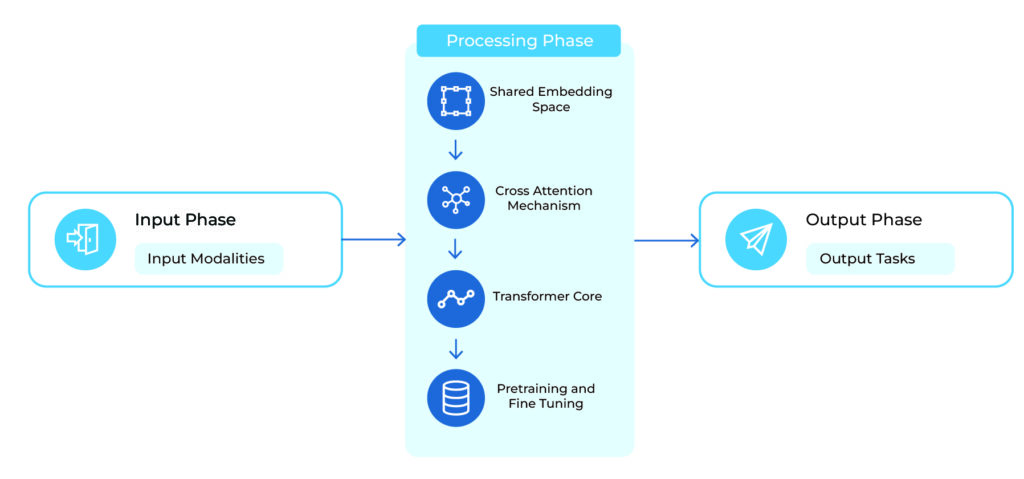
To enable multimodal understanding, AI systems rely on specialized architectures that integrate and process multiple data types simultaneously. Key components include:
- Shared Embedding Spaces: Convert text, images, and audio into a common representation for learning relationships
- Cross-Attention Mechanisms: Focus on the most relevant information across multiple modalities during prediction and response generation
- Transformer-Based Models: Efficiently process sequential data while supporting learning across multiple input modalities
- Pretraining and Fine-Tuning Pipelines: Learn from large paired datasets before adapting to specialized multimodal tasks
Benefits of Multimodal AI
The development of multimodal AI is complex, but its broad benefits are transforming how AI understands information and interacts with people and environments.
Deeper Contextual Understanding
Combines text, images, and audio to deliver richer, more accurate contextual understanding.
More Natural User Interaction
Supports communication through voice, text, and visuals for more intuitive user experiences.
Greater Accessibility
Provides flexible interaction methods that accommodate users with diverse accessibility and communication needs.
Versatility Across Tasks
Supports diverse applications, from document analysis to medical image interpretation with contextual information.
Cross-Modal Reasoning
Connects information across multiple data types to improve understanding and response accuracy.
Improved Decision Making
Integrates multiple data sources to support more accurate and informed decisions across industries.
What Is Next in the Multimodal AI Landscape?
As multimodal AI continues to evolve, it is expected to become more dynamic, context-aware, and accessible. Key trends shaping its future include:
- Real-Time Interaction: AI systems will process live video and audio for faster, context-aware decision-making
- Emotion Recognition: Advanced models will interpret tone, facial expressions, and body language more accurately
- Multilingual and Multicultural Understanding: AI will bridge communication across languages, cultures, and visual contexts
- Autonomous Systems: Intelligent robots and agents will act using combined visual, audio, and textual information
Conclusion
Multimodal AI is shaping the next generation of intelligent systems by enabling machines to interpret and reason across diverse forms of information. As the technology continues to evolve, it will deliver more intuitive, accessible, and adaptive experiences across industries, improving how people interact with AI and how organizations solve complex challenges. The future of AI extends beyond processing individual data types to creating systems that understand information holistically, generate deeper insights, and support smarter, more informed decision-making.