How Can Agentic AI Transform Manufacturing Maintenance?
Manufacturing facilities experience persistent unplanned machine downtime because, though operators can detect equipment failures, they need complete equipment data and immediate decision-making options to resolve problems. As a result, technicians rely on outdated manuals, disconnected systems, and their personal experience to determine the causes of failures and the appropriate solutions.
The United States will have 2.1 million unfilled manufacturing positions by 2030 because experienced technicians retire faster than the industry can find replacements. The problem exists because their equipment knowledge was never documented through proper processes, resulting in knowledge stored in outdated documents and systems that are disconnected. As a result, technicians need to retrieve all missing information manually when essential equipment breaks down, which leads to longer repair times and increased unplanned machine downtime.
Agentic AI and the Evolution of Maintenance Thinking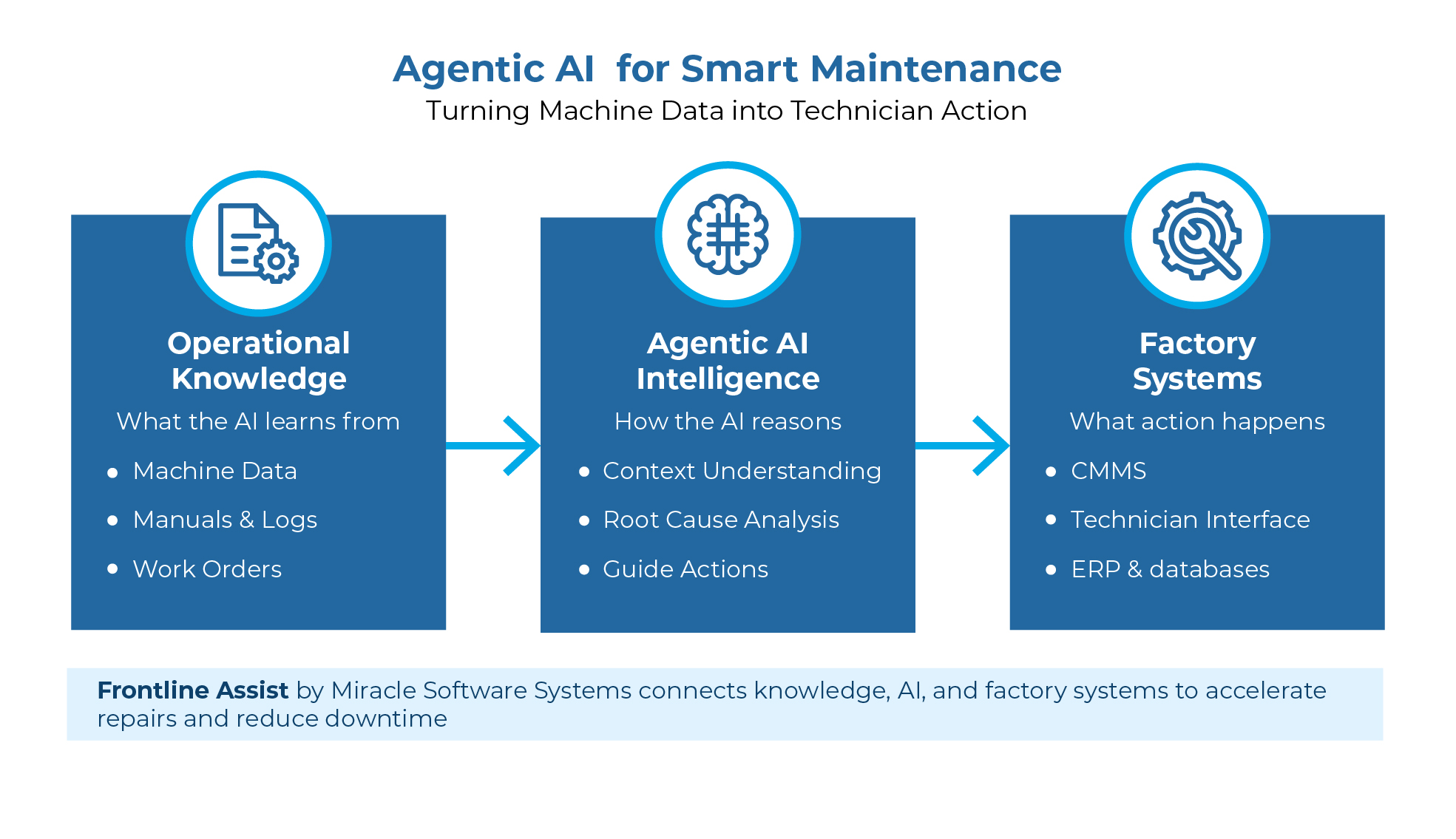
The maintenance teams now receive support through Agentic AI, which provides them with a new method to work. These systems use advanced reasoning abilities to process operational context together with historical repairs and manuals in order to assist technicians during system failures.
This marks a broader shift in AI in manufacturing maintenance; from predicting failures to actively guiding resolution. The real value of Agentic AI goes beyond predicting equipment failures. It enables teams to identify operational problems while working through the most efficient path toward restoring normal operations.
Key Factors Behind Rising Downtime
Many plants continue to experience downtime problems because their maintenance operations face existing constraints even after they invest in automation and analytics.
The major core factors include:
- Multiple versions of the same equipment documentation exist across systems
- Troubleshooting procedures applied without formal documentation
- Equipment knowledge held primarily by senior technicians
- Handwritten shift logs maintained in physical binders
-
Thousands of OEM manuals stored in PDF format
Together, the manufacturing process experiences unexpected shutdowns because of these particular circumstances. When failures occur, technicians are left with error codes and fragmented documentation, while predictive maintenance systems stop at detection. As a result, repairs take longer, outcomes vary, and reliance on external specialists increases.
How Agentic AI Works in Maintenance Operations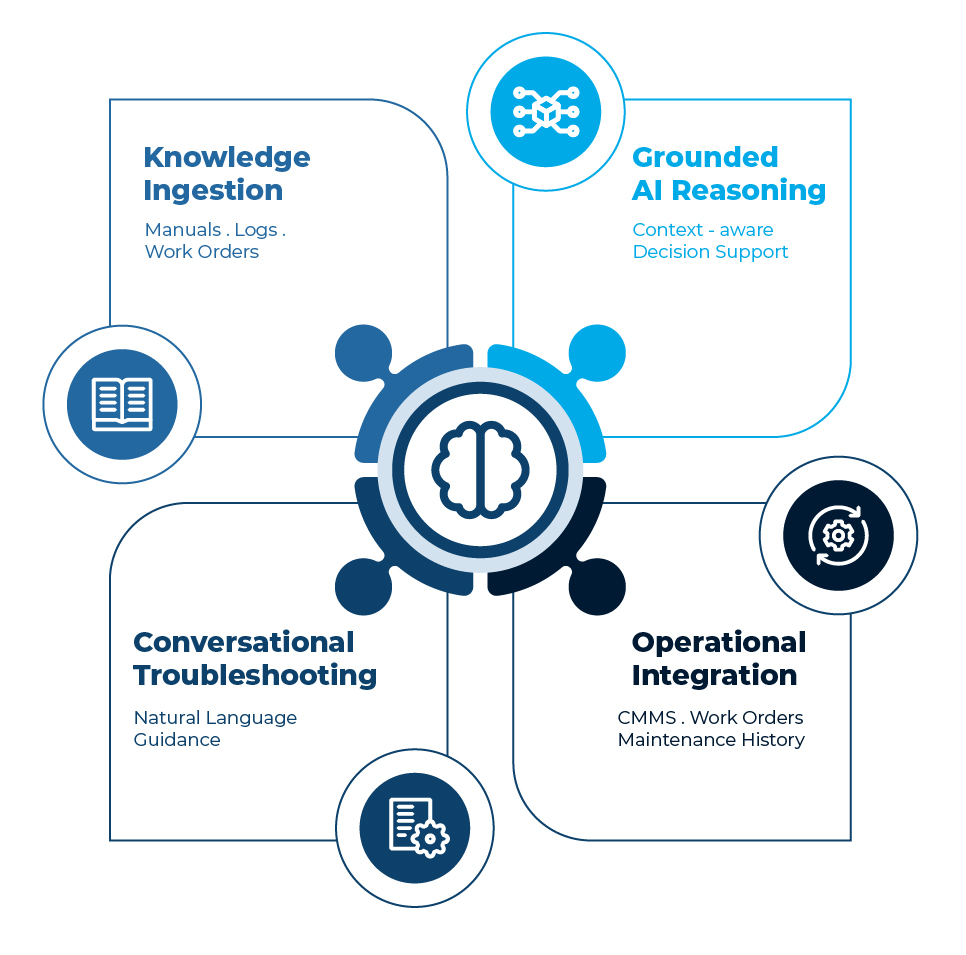
Agentic AI closes this gap by combining knowledge access with contextual reasoning. Accordingly, a practical implementation follows a clear operational flow.
Centralized Knowledge Ingestion
The system ingests equipment manuals, maintenance logs, work orders, shift notes, and failure analyses. It creates a living knowledge foundation that supports digital transformation in manufacturing without replacing existing tools or processes.
Grounded Reasoning and Retrieval
Using retrieval-augmented generation, responses are generated from verified internal sources to ensure reliability while allowing generative AI in manufacturing to interpret complex technical language accurately and consistently.
Conversational Troubleshooting
Instead of searching for documentation, technicians interact via natural language and receive prioritized guidance, likely root causes, and recommended next steps. This capability directly reduces machine downtime in manufacturing.
Operational Integration
Advanced deployments integrate with CMMS systems to display necessary work orders while displaying historical maintenance records, and they help decrease operational time requirements. As a result, manufacturers achieve a lower mean time to repair (MTTR) through this process.
Enter the AI Shift: A Practical Assistant for Technicians
When a machine stops, the issue is rarely a lack of data. The challenge lies in converting fragmented maintenance information into clear guidance under time pressure. To address this, Agentic AI delivers information in context, exactly when technicians need it, but can go beyond to provide additional help.
“mFrontlineAssist”, developed by the Miracle Labs team, demonstrates this approach in manufacturing environments by adapting to each facility’s equipment, operating conditions, and maintenance history.
In practice, the assistant supports technicians by:
- Combining manuals, work orders, shift notes, parts data, and failure history
- Linking error codes to similar past incidents on the same equipment
- Enabling conversational troubleshooting with prioritized, evidence-based guidance
- Using visual inputs, such as HMI screenshots, to guide repairs
- Generate new standard operating procedures
- Create training materials for new technicians joining the facility
- Automatically create/update work orders and create a Knowledge bank for future issues
As each issue is resolved, lessons are captured and reused, reducing reliance on individual memory and improving consistency over time.
Real-World Impact on the Factory Floor
The impact is visible immediately:
- Mean time to repair decreases.
- New technicians reach productivity faster.
- Each repair expands a growing, searchable knowledge base.
-
Emergency contractor usage declines.
This is how Agentic AI delivers measurable value, by moving teams from reactive troubleshooting to informed execution.
Path Forward
Unplanned downtime is not simply a maintenance issue. It is a knowledge and decision challenge amplified by skills shortages and fragmented systems. As AI in manufacturing maintenance continues to mature, advantage will accrue to organizations that reduce decision time by bringing insight closer to daily work. The current state of Industry 4.0 predictive maintenance requires businesses to establish complete systems that provide both operational alerts and systems that support staff members in fixing problems. Frontline Assist functions as a smart support tool for technicians, which provides them with relevant information at the right time to minimize equipment downtime while decreasing their need for manual problem-solving.
Now, the defining question is: when every minute of downtime impacts revenue, will you leave decisions to manual guesswork, or trust Frontline Assist to deliver precision at the point of action?