
How Platform Engineering Enables Structured Delivery
According to experts in the technology field, platform engineering is the future of software development. It simplifies the creation and management of applications. While DevOps has made it easier to bring development and operations teams together. However, organizations still face challenges such as operational overhead, inconsistent environments, and complex toolchains. Platform engineering addresses these issues by creating a centralized system that includes automated infrastructure, standardized workflows, and self-service tools.
How Platform Engineering Works
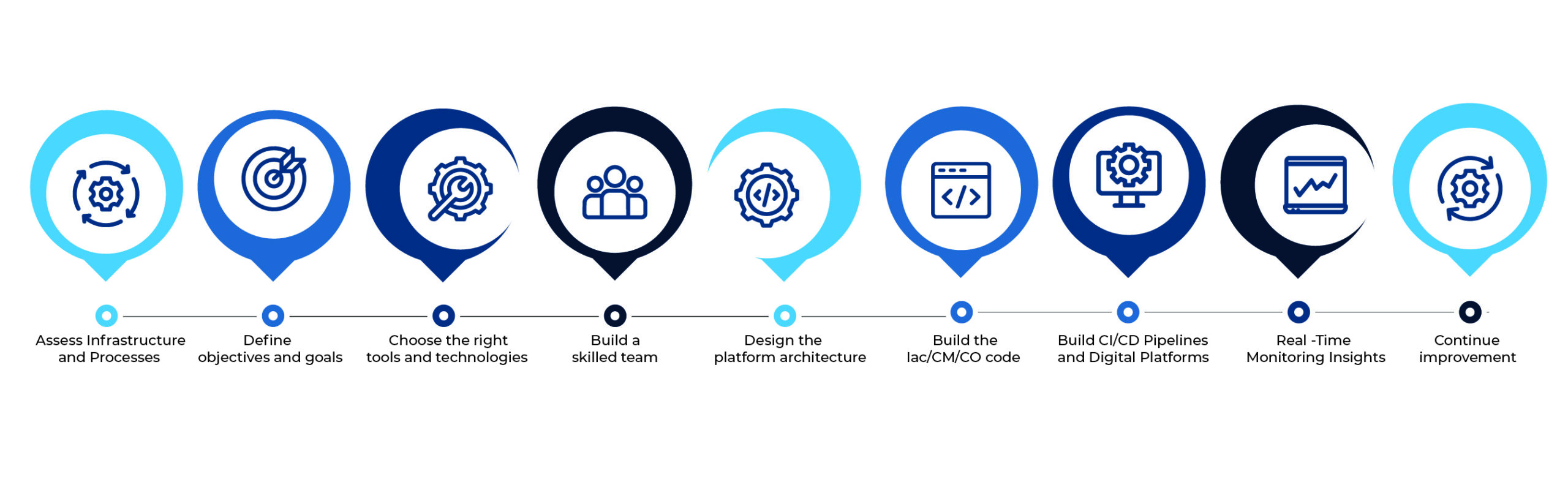 A platform team typically follows a structured lifecycle to build systems that developers can easily use.
Platform Engineering Lifecycle
1. Planning and Discovery – The Initial Phase
The first step is to understand the challenges developers face and identify operational inefficiencies. Based on these insights, platform teams define the roadmap for the internal developer ecosystem.
2. Platform Architecture
Engineers design CI/CD pipelines, deployment models, security guidelines, and reusable deployment components. This ensures security, consistency, and scalability across environments.
3. Platform Development
Engineers build the framework using technologies like Infrastructure as Code (IaC) and containerization. This helps create consistent environments and reduces the need for manual setup and configuration.
4. Toolchain Integration
All development and operational tools are integrated into a single environment, including security, monitoring, and version control. This makes workflows easier to manage and reduces the need to switch between multiple tools.
5. Enabling Self-Service
Developers can provision environments and deploy applications on their own using simple commands or dashboards. This reduces delays and allows teams to work more independently without relying on others.
6. Security Integration
Security is embedded into the platform through tools for scanning and access control. This ensures that applications follow required security standards from the early stages and reduces risks during development.
7. Platform Operations
The platform team manages system stability, handles updates, and resolves issues as they arise. This ensures the interface remains reliable and continues to support development without delays or interruptions.
8. Monitoring and Observability
Cloud environment and applications are continuously monitored to detect failures and performance issues. This helps teams identify problems early and respond quickly to maintain system stability.
9. Continuous Improvement
Feedback from development teams is regularly collected and used to refine the architecture over time. This helps ensure it stays aligned with team needs and remains effective as requirements evolve.
Purpose of Platform Engineering
The key objectives of platform engineering are:
- Simplify operational management for developers
- Standardize software development and deployment processes
- Improve system reliability and scalability
- Strengthen security and compliance
- Accelerate software delivery cycles
Instead of each team building its own infrastructure processes, a dedicated platform engineering team creates standardized solutions that all teams can leverage.
Core Elements of Platform Engineering
Internal Developer Platform (IDP)
The IDP is the foundation of platform engineering. It is a centralized, self-service ecosystem that provides infrastructure, tools, automation, and deployment capabilities.
Containerization and Orchestration
Technologies such as Docker and Kubernetes are used for efficient application deployment and management.
Infrastructure Automation
Infrastructure management is automated using Terraform. This means that infrastructure management does not require manual management; rather, it is done programmatically.
Continuous Integration and Deployment (CI/CD)
CI/CD pipelines streamline development workflows. Tools like Jenkins enable automated build, test, and deployment processes.
Observability and Monitoring
Tools such as Grafana and Prometheus provide real-time insights into system performance and health.
Policy and Security Controls
Security frameworks are integrated to enforce policies and reduce risks, maintaining consistent security practices across the platform.
Developer Experience (DevEx)
A key focus is improving developer productivity by simplifying platform interactions and reducing friction.
DevOps vs. Platform Engineering
DevOps focuses on fostering collaboration between development and operations teams. It emphasizes shared responsibilities such as building, testing, deploying, and maintaining applications. The primary goal is to accelerate software delivery while maintaining reliability.
Platform engineering builds on DevOps principles by creating reusable internal platforms that support development teams. This approach enhances productivity, scalability, and system reliability, allowing developers to focus more on application development rather than infrastructure management.
In essence, platform engineering operationalizes DevOps by transforming its principles into reusable infrastructure services and standardized platforms.
Conclusion: Why Platform Engineering is the Future
Platform engineering represents the next evolution of DevOps. By building automated internal platforms, organizations can significantly improve developer productivity and streamline workflows. It extends DevOps principles by combining operational expertise with scalable platform design, enabling organizations to build efficient, reliable, and developer-friendly systems.