AI + Spring Boot: From Experimentation to Enterprise Reality
Integrating AI into Spring Boot applications is becoming essential as AI moves from experimentation to enterprise adoption. Features like recommendation engines, fraud detection, personalization, automation, and decision intelligence are now core requirements for modern systems. At the same time, Spring Boot continues to power a significant share of enterprise backend applications by supporting business workflows, system integrations, security enforcement, and both horizontal and vertical scalability.
This raises a common question for Java teams:
Is integrating AI into Spring Boot applications a powerful opportunity or a practical challenge?
The reality is this: AI and Spring Boot form a powerful combination when integrated with the right architectural mindset.
The Myth: “To Use AI, You Must Switch to Python”
One of the biggest misconceptions in AI adoption is that backend engineers must abandon Java and move entirely to Python to remain relevant. In enterprise systems, AI models are typically exposed through APIs, microservices, or cloud platforms that integrate seamlessly with existing architectures.
- Models are trained separately: Training occurs on specialized ML platforms using large datasets outside production systems
- Models are deployed as inference services: Trained models are exposed as flexible, standalone inference services
- Models are accessed through APIs: Business applications connect to AI services, such as external enterprise systems
How AI Fits into a Spring Boot-Based System
In enterprise environments, AI functions as a specialized intelligence layer rather than the core business application.
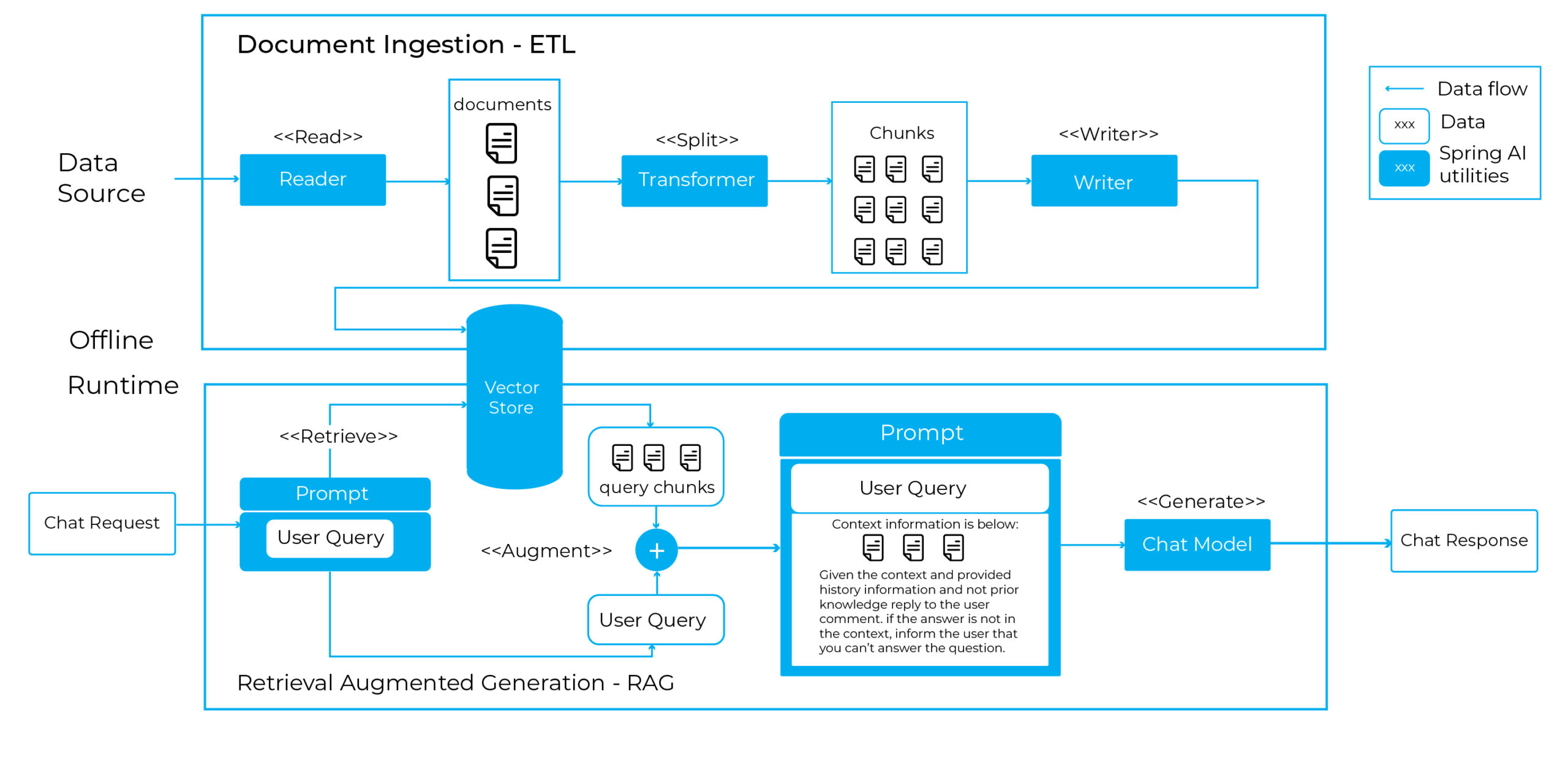
Integrating AI into Spring Boot architecture
Typical Architecture Breakdown
Spring Boot Services
These act as the system of record and handle:
- Business rules and deterministic logic
- Transaction management and data consistency
- Security, authentication, and authorization
- Workflow orchestration and process coordination
AI / ML Services
These focus on intelligence-driven capabilities such as:
- Predictions, recommendations, and pattern recognition
- REST or gRPC-based model communication
- Independent scaling for inference and compute workloads
Clients (Web / Mobile / External Systems)
- Interact only with Spring Boot APIs
- Never communicate directly with AI services
This architecture enables secure and adaptable AI integration while maintaining system stability and control.
Spring Boot as the “Decision Layer”
One of the most important principles in AI-enabled systems is:
AI predicts. Spring Boot decides.
AI generates probabilistic outputs such as scores, rankings, and recommendations.
Spring Boot applies deterministic logic through:
- Business policies that define organizational rules and operational constraints
- Thresholds that establish confidence cutoffs for automated actions
- Regulatory rules that enforce compliance and legal requirements
- Fallback logic that enables safe default actions when AI confidence is low
This approach allows AI to enhance insights while Spring Boot ensures governance, consistency, and reliable decision-making.
Practical Examples
Fraud Detection
- AI predicts a fraud risk score
- Spring Boot decides whether to approve, review, or block the transaction
Personalized Content
- AI suggests content that may be relevant to the user
- Spring Boot determines eligibility, timing, and delivery
This approach keeps business accountability outside the AI model, which is critical for enterprise-grade systems.
Why Spring Boot Is a Strong Foundation for AI Integration
1. Production-Grade API Consumption
Spring Boot provides mature capabilities for:
- REST and gRPC communication: reliable service-to-service interactions
- Timeouts and retries: preventing cascading failures
- Circuit breakers: isolating failing AI services
- Observability and logging: supporting metrics, traces, and logs
- Secure credential handling: managing secrets and access tokens
From an architecture perspective, calling an AI service is similar to calling any external service. The difference is that AI returns intelligent insights.
2. Clear Separation of Responsibilities
Spring Boot supports:
- Domain-Driven Design (DDD): business logic centered on domain concepts
- Layered architectures: controller, service, repository separation
- Explicit contracts: well-defined API boundaries
This keeps AI logic separate from controllers, databases, and core business rules, allowing AI services to evolve without impacting system stability.
3. Event Driven Intelligence
In modern systems, AI is often triggered asynchronously :
- Spring Boot publishes events through Kafka or RabbitMQ
- AI services process events in near real-time
- Results are returned to business workflows
This enables high throughput, loose coupling, and flexible real-time intelligence while keeping Spring Boot responsive.
Real World Use Cases for This Architecture
- Intelligent Decision Engines: Spring Boot integrates AI insights, enterprise data, and business rules to enable compliant decisions
- Personalization at Scale: AI drives recommendations while Spring Boot enforces governance and compliance controls
- Automation and Smart Operations: AI detects anomalies while Spring Boot manages workflows, alerts, approvals, and human oversight
Addressing Key Challenges in AI Integration
Reliability and Model Drift
AI models can become less accurate over time. Spring Boot helps by:
- Validating confidence levels
- Applying decision thresholds
- Routing uncertain cases for manual review
Security and Compliance
Spring Boot strengthens enterprise security through:
- Centralized authentication
- Role-based access control (RBAC)
- Auditable request and decision tracking
Operational Stability
If AI services fail or slow down, Spring Boot can:
- Apply fallback logic
- Degrade gracefully
- Maintain system availability
What This Means for Java and Spring Boot Developers
AI is not replacing backend engineering. It is increasing the need for strong enterprise architecture skills. The most valuable developers are those who can:
- Build distributed systems
- Integrate AI responsibly
- Balance automation with governance
Spring Boot developers already have these capabilities. AI is not a separate ecosystem. It is an extension of modern enterprise architecture.
Final Thoughts
Spring Boot and AI are complementary technologies. AI delivers intelligence and adaptability, while Spring Boot provides governance, scalability, and operational reliability. Together, they enable enterprise systems that are intelligent, explainable, and production-ready. The organizations that succeed with AI will not be those treating it as isolated experimentation, but those embedding intelligence directly into core business systems.