
AOA vs. Microservices: Understanding the Future of Enterprise Architecture
For more than a decade, microservices have been a leading architectural approach for building scalable, modular, and cloud-native applications. By breaking monolithic systems into smaller, independently deployable services aligned with business capabilities, organizations have improved development agility, team autonomy, and deployment speed. This architecture has also enabled greater flexibility in scaling applications and managing complex enterprise systems. Organizations transitioning from traditional monolithic systems can explore Navigating the Transition from Monolithic to Microservices Architecture to understand the architectural evolution toward modular, scalable applications.
However, evolving business demands are pushing software architectures beyond predefined workflows and traditional service interactions. Modern platforms must increasingly interpret context, adapt to changing conditions, make decisions, and coordinate actions toward broader business outcomes. This shift is bringing Agent-Oriented Architecture (AOA) into focus, raising an important question: How can organizations combine the operational reliability of microservices with the adaptive intelligence of autonomous agents?
What Is Microservices Architecture?
- Microservices Architecture divides an application into smaller, independent services, each responsible for a specific business function
- Each service can be developed, deployed, and scaled independently, improving application flexibility and operational efficiency
- This architecture supports clear team ownership, allowing different teams to manage and maintain individual services
- Microservices communicate through APIs and messaging systems, supporting well-defined interactions and controlled business operations
What Is Agent-Oriented Architecture?
Agent-Oriented Architecture is built around autonomous agents that understand context, make decisions, and adapt their actions to achieve defined goals. Rather than following fixed workflows, organizations establish objectives while agents determine appropriate execution paths. Agents collaborate with tools and other systems to respond to changing conditions, supporting use cases such as AI copilots, customer support, logistics, incident management, and adaptive automation. Organizations exploring enterprise adoption can leverage Agentic Automation services to design, orchestrate, and implement intelligent agents that automate business workflows and coordinate activities across enterprise systems.
Core Philosophical Difference
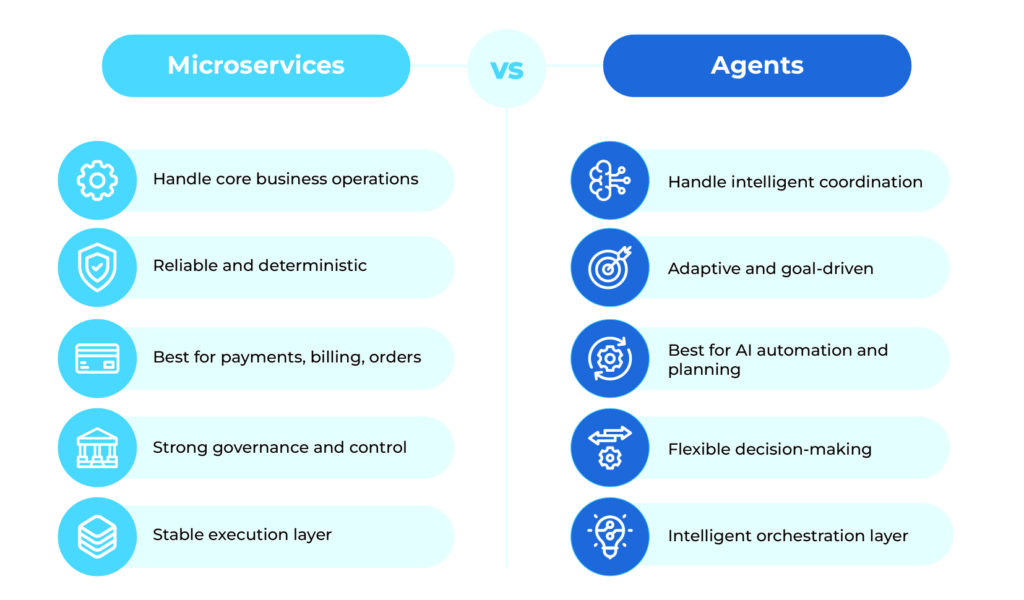
The most important difference between microservices and agent-oriented systems is that microservices are capability-oriented, while agents are goal-oriented. A microservice is designed around a specific business function, such as payments, inventory, notifications, or identity validation, and provides reliable, consistent execution. By contrast, an agent focuses on achieving an objective. This goal-driven behavior is further explained in Agentic AI: Multi-Agent System Using Google’s Agent Development Kit, which demonstrates how specialized agents collaborate through intelligent delegation and coordination. It can evaluate options, coordinate across services, and adapt its actions when conditions change.
Microservices provide structured execution for well-defined business operations, whereas agent-oriented systems introduce context-aware decision-making for situations that require greater adaptability.
Strengths of Microservices
- Reliable and Predictable Execution: Microservices provide consistent execution, which is essential for systems such as payments, banking, and billing.
- Clear Team Ownership: Different teams can manage individual services independently without disrupting other parts of the application.
- Independent Scalability: Organizations can scale specific services based on demand rather than scaling the entire application.
- Mature Ecosystem and Tooling: Established tools support deployment, monitoring, security, retries, and fault tolerance.
- Suitable for Critical Business Systems: Microservices support systems that require stability, compliance, auditability, and high performance.
Strengths of Agent-Oriented Architecture (AOA)
- Adaptive Decision-Making – Agents can interpret goals, evaluate situations, and dynamically determine appropriate actions.
- Dynamic Planning and Execution – When failures occur or conditions change, agents can adjust their plans instead of following predefined execution paths.
- Handles Uncertainty – Agents are useful when inputs are incomplete, ambiguous, or constantly changing.
- Natural Language and AI Integration – Agents can process natural language, work with semi-structured data, and support AI-driven interactions.
- Intelligent Process Coordination – Well suited for AI copilots, customer support, logistics, incident response, and personalized workflows.
The Hybrid Model: Agents on Top of Microservices
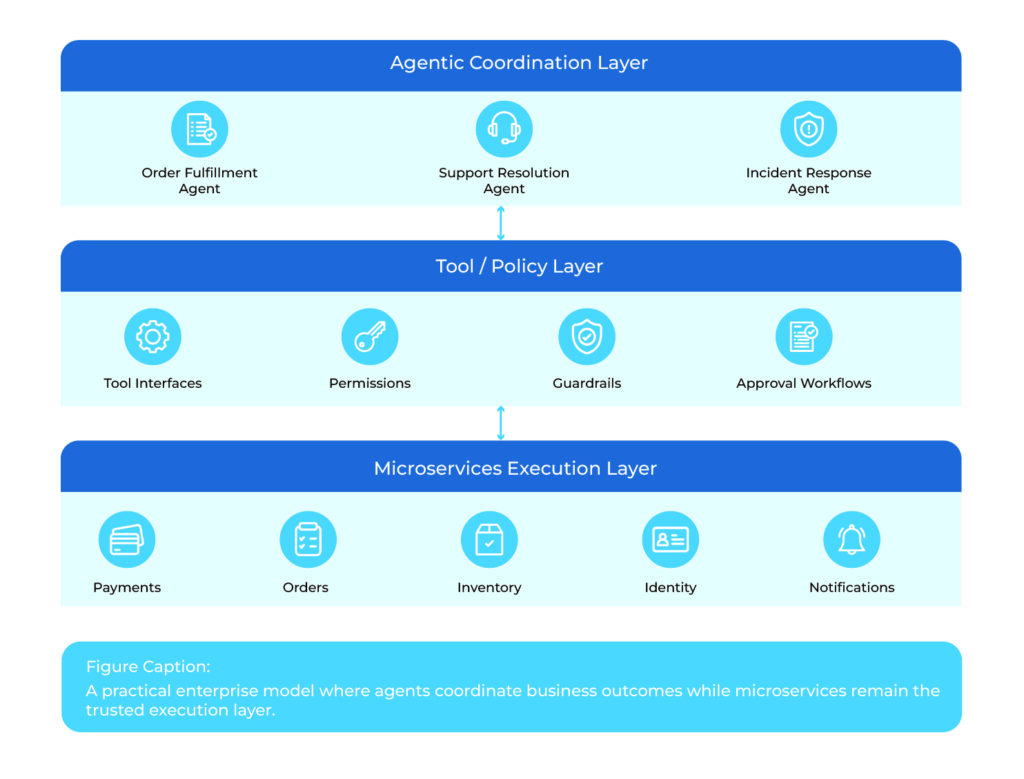
For most organizations, the practical approach is not to choose between microservices and agent-oriented architecture but to combine them. In this hybrid model, microservices remain the deterministic execution layer, managing core business functions such as payments, orders, inventory, identity, billing, and compliance. They provide a stable, governed, auditable, and independently scalable operational foundation. The integration of AI capabilities into traditional service architectures is also demonstrated in AI-Powered Microservices Architecture Using Spring Boot, which explores how AI capabilities can be incorporated into independently deployable microservices.
An agentic coordination layer interacts with these services through APIs, tools, and controlled interfaces. It interprets business objectives, identifies relevant services, coordinates actions, handles exceptions, and adjusts execution plans when conditions change.
This approach introduces AI-driven coordination without requiring organizations to replace their existing service architecture. Agents operate within defined permissions and policy controls, with appropriate validation and human oversight for sensitive operations. This separation allows enterprises to introduce intelligent decision-making while retaining control over critical business execution.
When Should You Choose Microservices?
- Predictable Workflows: Best suited for business processes with stable rules and clearly defined execution paths
- Reliability and Consistency: Ideal for systems requiring reliable execution, auditability, and traceability
- Transactional Systems: Well suited for banking, payments, billing, ERP, and SaaS platforms
- Clear Team Ownership: Effective when teams independently manage specific business domains and services
- Large-Scale Operations: Suitable for organizations with mature DevOps practices, platform engineering, and scalability requirements
When Should You Choose AOA?
- Dynamic Environments: Best suited for systems that must adapt to changing conditions and unpredictable scenarios
- Ambiguous Inputs: Useful when processing natural language, incomplete information, or unclear user intent
- Intelligent Decision-Making: Enables agents to evaluate options, adjust plans, and determine appropriate actions dynamically
- AI-Driven Use Cases: Ideal for AI copilots, support automation, research assistants, and autonomous workflows
- Goal-Oriented Processes: Valuable when adaptability and intelligent automation deliver measurable business value rather than simply following technology trends
Microservices vs. Agents: Key Differences
Final Verdict
The future of enterprise architecture will not depend on choosing between microservices and agents but on combining their strengths. Organizations can leverage the deterministic reliability of microservices alongside the adaptive intelligence of agents. As AI becomes increasingly integrated into business operations, architectures that separate execution from decision-making will provide the flexibility, resilience, and scalability needed to support evolving enterprise requirements.