
Introduction: How AI Is Transforming Modern Security
As cyber and physical threats grow more advanced, traditional security systems struggle to keep up. From sophisticated phishing attacks and ransomware to insider threats and coordinated cyber intrusions, static rule-based tools are no longer enough. Organizations today require real-time, adaptive, and predictive security systems.
This is where Artificial Intelligence (AI) in security is redefining the security landscape. By combining machine learning, behavioral analytics, and automation, AI enables organizations to detect threats faster, respond proactively, and reduce human error. AI is no longer just assisting security teams. It is reshaping security from prevention to real-time defense.
Applications of AI in Security
1. AI in Cybersecurity: Combating Modern Cyber Threats
AI-powered cybersecurity solutions have become a core defense mechanism for enterprises worldwide. Technology leaders such as Google and Microsoft use AI-driven security platforms to detect and neutralize threats at scale. For example, Microsoft Defender leverages machine learning to analyze trillions of signals daily, helping prevent billions of malware, phishing, and ransomware attacks, including zero-day threats, before they spread.
Key Cybersecurity Use Cases of AI
- Threat Detection and Prevention: AI models continuously monitor network traffic, user behavior, and system activity to detect anomalies such as unusual login attempts, data exfiltration, or suspicious access patterns. Unlike traditional tools, AI adapts to evolving attack methods in real time.
- Phishing and Fraud Prevention: Modern AI systems analyze not only links and attachments but also email writing style, tone, and sender behavior. If a message deviates from known communication patterns, it is flagged as suspicious, adding a behavioral layer that static filters often miss.
- Automated Threat Mitigation: In enterprise environments, AI can automatically isolate compromised devices, block malicious IPs, or trigger rollback mechanisms without waiting for human intervention. This rapid response helps prevent small breaches from escalating into large-scale incidents.
2. AI in Surveillance and Physical Security
AI is also transforming physical security and surveillance systems across industries such as retail, transportation, and critical infrastructure. Retailers use AI-powered video analytics not only to reduce theft but also to analyze foot traffic and optimize store layouts and staffing. Airports deploy AI-based surveillance to detect unattended baggage, erratic movement, or potential safety risks in real time.
Key Physical Security Applications
- Facial Recognition Systems: AI-enabled facial recognition enables instant identity verification at secure access points, such as airports, offices, and restricted facilities. While these systems significantly improve security efficiency, they also raise concerns around privacy, bias, and data governance, making responsible deployment essential.
- Behavioral Analytics: AI models trained on movement and activity patterns can identify abnormal behavior such as loitering, sudden crowd formation, or unusual motion. By detecting these anomalies early, security teams can intervene before incidents escalate.
- Autonomous Drones and Robots: AI-powered drones and ground robots are increasingly used in border security, industrial facilities, and remote locations. Equipped with thermal imaging and object recognition, they operate continuously and provide real-time intelligence in dangerous or inaccessible environments.
3. AI in National Security and Law Enforcement
Governments and law enforcement agencies rely on AI to process vast volumes of data and respond to threats more efficiently. From cybersecurity incidents to public safety risks, AI accelerates intelligence gathering and decision-making.
AI Use Cases in Public Safety
- Predictive Policing: AI-driven crime analysis models help law enforcement allocate resources more effectively by predicting where incidents are likely to occur. While this improves response times, it also raises ethical concerns related to bias and fairness.
- Counterterrorism and Intelligence Analysis: AI systems analyze communications, financial transactions, and travel data to uncover hidden connections and potential threats. By linking disparate data sources across agencies and borders, AI enables earlier threat detection, while emphasizing the need for strict oversight to protect civil liberties.
Challenges and Risks of AI-Driven Security
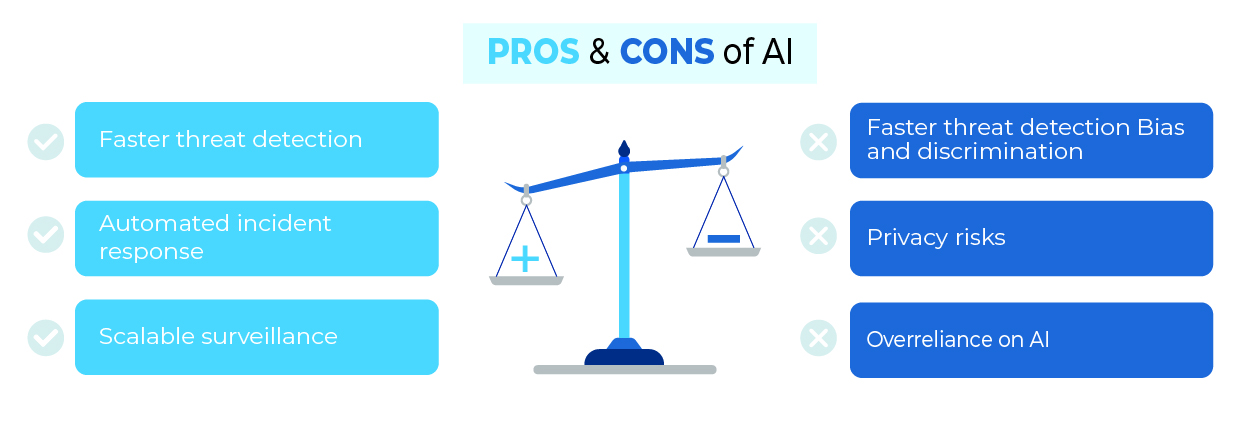
Despite its benefits, AI in security presents significant challenges that organizations must address.
Bias and Discrimination
AI systems can inherit biases from training data, leading to unfair profiling or false positives, especially in facial recognition and predictive policing applications.
Privacy and Civil Liberties
Continuous data collection and surveillance raise serious concerns about individual privacy, consent, and misuse of personal information.
Security of AI Systems
AI itself can be targeted through adversarial attacks, data poisoning, or model manipulation, potentially causing systems to misclassify or overlook threats.
Overreliance on Automation
While automation improves speed, excessive dependence on AI can reduce human judgment. Skilled attackers are increasingly designing threats to evade AI-based detection.
Lack of Transparency
Many AI models operate as “black boxes,” making it difficult to explain decisions, particularly in high-stakes areas like national security and law enforcement.
AI in Security: Promise and Pitfalls
Ethical AI in Security: Governance and Responsible Use
As AI becomes central to security strategies, strong ethical frameworks and accountability mechanisms are critical to maintaining trust.
Best practices for responsible AI in security include:
- Regular auditing of AI models for accuracy, bias, and performance
- Adoption of Explainable AI systems to improve transparency
- Ensuring human oversight, especially in sensitive applications
- Establishing independent governance committees for public-sector use
Regulatory initiatives such as the EU AI Act and the U.S. Blueprint for an AI Bill of Rights are shaping responsible AI deployment in security-sensitive environments.
Conclusion: The Future of AI-Powered Security
AI is transforming security from a reactive defense model into a proactive, intelligent, and adaptive system. It enables faster threat detection, smarter prevention, and real-time response at a scale beyond human capability.
However, the future of security depends not only on more advanced AI, but on ethical deployment, transparency, and human oversight. Organizations that balance innovation with responsibility will be best positioned to build secure, trusted, and resilient systems in the AI-driven era.